Tuesday, 22 March 2022

Great x3 Uncle Charles 'Charlie' James

My Great x3 Uncle Charles 'Charlie' (1883 - 1965) was a rabbit catcher/trapper/dealer, father of two, and a younger brother of my Great x2 Grandmother Lucy Vernon (nee James) (1868 - 1897).


Charles was born on 1st April 1883 in Morchard Bishop, Devon, to Henry James (about 46), an agricultural labourer, and Louisa James (nee Edwards) (about 34), a housewife.

Charles was baptised on 13th May 1883 in Morchard Bishop. At the time of Charles' baptism, the family lived at Watcombe/Whatcombe [farm or more likely cottage].

Charles was the sixth of eight children (four daughters and four sons):

  • Lucy  1868 - 1897  (29 years old)
  • Bessie  1869 - 1945 or 1956  (77 or 86 years old)
  • Edwin  1875 - 1896  (21 years old)
  • Louisa  1878 - 1966  (87 years old)
  • Emily Maude  1880 - 1967  (86 years old)
  • Charles  1883 - 1965  (82 years old)
  • Francis Robert  1886 -
  • Gilbert 1889 -

Charles and his siblings grew up in Morchard Bishop.

1891 Census:

When Charles was a young teen, two of his older siblings passed away in their twenties. In July or August 1896, Charles' older brother Edwin passed away, aged only twenty-one, in East Worlington. Less than a year later, in March 1897, Charles' eldest sister Lucy passed away, aged twenty-nine, of TB, in Kennerleigh. I wonder if brother and sister both succumbed to the same disease.

By his late teens, Charles was working as a rabbit trapper. He lodged with the Gale family, headed by butcher Charles Gale, in Lapford.

1901 Census:

Charles may have been close to his sister closest to him in age, Emily, for it was him - rather than their father Henry - who gave Emily away at her wedding in Exeter in 1904.

Alas Charles came up against the law an several occasions...

Firstly, on Christmas Eve (24th December) 1901, he was fined 11s, at Chumleigh, according to the ground game act. Was he catching rabbits when/where he shouldn't have been?

Secondly, he was found not guilty of unlawfully and maliciously wounding (with a piece of glass) one Arthur Ash, with intent to do him grievous bodily harm, at North Tawton, on the 27th July 1904. 

What had happened? 

Essentially it was a pub brawl. 

On the evening of 27th July, Charles was sat drinking at the bar of the Gostwyck Arms in North Tawton. Three lads had been there: Charles James, somebody Moore and Sidney Ash. Another, a witness called Skinner, later became involved. 'Chaffing remarks' were exchanged, which resulted in Charles offering to fight Moore and Sidney Ash. He struck Sidney Ash, knocking him against the wooden partition. Sidney then said he would fetch his brother Arthur Ash, though he did not. Yet soon after in the road they met Arthur Ash, who asked Charles why he had hit his brother. Arthur then stuck Charles in the face. A fight ensued. Later to the court, Arthur showed off cuts to his person and coat that the piece of glass had made. Yet Charles, the defence argued, had not one single cut to his hand, which would have been expected if he was holding tight to and using a piece of glass as a weapon. Charles denied ever having the glass, let alone using it, though he admitted to using his fists after Arthur Ash first struck him. Everyone had been drunk and fighting each other and it was dark. The rumour going around was that it was in fact Skinner (remember him) who was striking Arthur Ash with the glass, having mistaken Arthur Ash for Charles. 

'There was a great degree of confusion and they were fighting one across the other'. So it was argued in their drunken haze, on that dark country road, Arthur Ash and whatever-his-christen-name-was Skinner each believed they were fighting Charles James, but they were in fact fighting each other. And sure drunken brawls were one thing, but bringing a shard of glass to a fist fight was considered beyond the pale. [I'm a pacifist and a teetotaller, I've no idea of the unwritten rules of drunken fights in or outside of pubs. Are there any?]

From the Western Times of 29th July 1904:


From the Western Times of 5th August 1904:


From the Western Times of 21st October 1904:


Interestingly his crime record of 1904 gives Charles' 'degree of instruction' (Can the prisoner read and/or write? N (No), R (Only read), Imp (Imperfectly) or Well)) as 'well'. Though only a poor rabbit trapper, he could read and write well.


In September 1906, before the bench at the Moretonhampstead Petty Sessions, Charles summoned a young man called Henry Long for stealing six of his rabbit traps from Cocktree Farm. Long pleaded guilty and was fined £1.

From the Western Times of 26th September 1906:

By 1910, in his late twenties, Charles was sometimes going by his birth name of Charles James and sometimes under the alais of Charles Scott James or Scott James. He also seems to have knocked a couple of years off his age - giving his age as 25 in 1910, when he would have really been 27. He is also giving his profession not simply as rabbit catcher or trapper but a dealer of rabbits.

By 1910, he had been convicted twice under the Game Law and once the Highway Act (between 1901 and 1908).

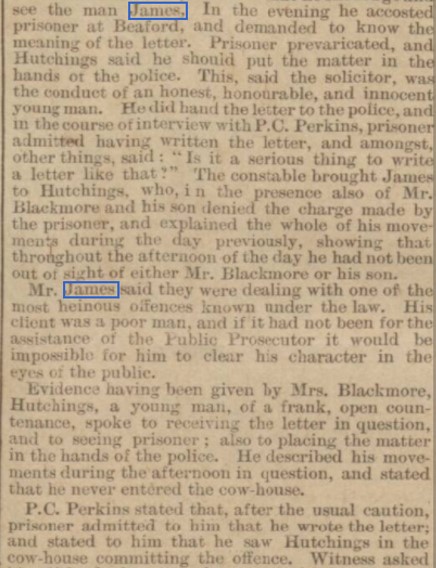
In 1910, Charles was again arrested and this time for a more serious offence. He was found Guilty of sending a threatening letter accusing one James Henry Hutchings of an infamous crime to extort money (eg give me x amount of money or I'll tell the police what I saw), on 15th February 1910, and sentenced to 12 months imprisonment with hard labourer. 

From North Devon Journal of 24th March 1910:


Charles' 1910 Prison record:


The 1911 Census shows Charles, a prisoner in Exeter prison on New North Road.

1911 Census:

In Oct/Nov/Dec 1915, Charles (about 32), rabbit trapper, married Alice Maud Brend (about 26), a domestic maid and housekeeper, in the district of Barnstaple.

Charles and Alice had two children (one son and one daughter):

  • Victor Charles  1920 -
  • Beatrice Hazel Valentine  1922 -
(The name Victor grew in popularity after the victories of WWI. The few Victors I have in my family, great uncles and distant cousins, were born in the 1920's.)

At some point around the 1910s/1920's, Charles and his family moved to Saunton, Braunton, on the North-West coast of Devon, where they would live for many years. Charles' older sister Louisa Tonkin(s) and husband Walter also lived in Braunton for a few years around 1939.

In June 1928, Charles found the body of commercial traveller Henry George Gilbert on Braunton sands, near the lighthouse. Gilbert had been out sailing, there had been some sort of accident, and he had drowned. 

(Somewhat eerily, Charles' nephew Leonard James Tonkin(s) (younger son of Charles' sister Louisa) would also find the body of a drown victim. In 1938, Leonard found the body of of 21-year-old Alfred Channon in the River Otter, at the Honiton Swimming Club Headquarters. In this case, the coroner gave a reluctant verdict of suicide by drowning.)

Charles and Alice's marriage may not have been one made it heaven. Charles put a notice in the North Devon Journal of 16th April 1931 that he would 'not be answerable for any Debts incurred by [his] wife':


However, they still appear together on the 1939 census, and by the time of Alice's death in 1948.

1939 Census:

By the early 1940's, Charles and Alice's young adult daughter Beatrice had married and was living in London - where she would live until her death, aged ninety-two, in 2014. And at some point their son Victor it seems may have moved to live in Scotland. However both children returned to Devon in 1948 to attend their mother's funeral.

In January or February 1948, Charles' wife Alice passed away, aged about 58. Her funeral took place on 19th February 1948 at St Brannock's, Braunton. It was attended by family and friends, including Charles' sister Emily and her husband Sam Trigger, and Charles' brother Francis and his wife.

From the North Devon Journal of 26th February 1948:

In Oct/Nov/Dec 1965, Charles himself passed away, aged eighty-two, in the district of Barnstaple.

Saturday, 12 June 2021

Great x3 Aunt Emily 'Em' Maude Trigger (nee James)

My Great x3 Aunt Emily 'Em' (1880 - 1967) was a domestic housemaid, housewife, and a younger sister of my Great x2 Grandmother Lucy Vernon (nee James) (1868 - 1897).

Emily was born on 4th October 1880 in Morchard Bishop, Devon, to Henry James (about 43), an agricultural labourer, and Louisa James (nee Edwards) (about 34), a housewife.

Emily was baptised Christmas Day (25th December) 1880 in Morchard Bishop.

Emily was the fifth of eight children (four daughters and four sons):

  • Lucy  1868 - 1897  (29 years old)
  • Bessie  1869 - 1946 or 1956  (77 or 86 years old)
  • Edwin  1875 - 1896  (21 years old)
  • Louisa  1878 - 1966  (87 years old)
  • Emily Maude  1880 - 1967  (86 years old)
  • Charles  1883 -
  • Francis Robert  1886 -
  • Gilbert  1889 -

Emily and her siblings grew up in Morchard Bishop.

1881 Census:

1891 Census:

When Emily was a teenager, two of her older siblings passed away in their twenties. In July or August 1896, Emily's older brother Edwin passed away, aged only twenty-one, in East Worlington. Less than a year later, in March 1897, Emily's eldest sister Lucy passed away, aged twenty-nine, of TB, in Kennerleigh. I wonder if brother and sister both succumbed to the same disease.

Emily as a young woman.

Emily is stood centre, with her mother Louisa sat left, and older sister Louisa sat right, c. 1900.

Close up of Emily as a young woman, c 1900

As a young woman, Emily moved to Exeter, where she worked in service. The 1901 Census shows twenty-year-old Emily working as a domestic housemaid for and living with the Osmond family - elderly retired land agent Edward Osmond and his spinster daughters Ellen and Bertha - at The Hermitage, 31 Union Road, Exeter. Emily was one of two live-in servants - the other being seventeen-year-old Mary Frigger [or Trigger? possibly a sister or cousin of Emily's future husband Samuel Trigger], a domestic cook.

1901 Census:


On 7th September 1904, Emily (23), a domestic housemaid, married Samuel Trigger (24), a carman for the Great Western Railway, at St James's in Exeter. 

From the Western Times of 8th September 1904:


At the 1908 Exeter Annual Cart Horse Parade, reported to have been a 'splendid show', Samuel was one of three winners of The Shire Horse Society's silver medals, offered for the best heavy breed carthorses engaged in town work.

The 1911 Census shows Emily and Samuel, by then in their early thirties, living at Cowley Cottages, Upton Pyne. They had no children.

1911 Census:

On the afternoon of 21st March 1920, whilst out walking along the Stoke Canon Road in Exeter, Emily and Samuel were knocked down and badly injured by a speeding St John's ambulance. The driver was drunk. Samuel was knocked down from behind, thrown into the air and pitched on his head. He was rendered unconscious. His head was cut and both shoulders and one leg were damaged. One tooth was knocked out. He was very much bruised and cut. Emily was thrown into the hedge and very much shaken.

From the Exeter and Plymouth Gazette of 29th April 1920:


1939 Census:

In Apr/May/Jun 1966, when Emily was eighty-five, her husband Samuel passed away, aged eighty-seven, in Exeter. About a year later, on 2nd June 1967, Emily herself passed away, aged eighty-six, also in Exeter. 

Friday, 11 June 2021

Great x3 Aunt Louisa Tonkin(s) (nee James)

My Great x3 Aunt Louisa (1878 - 1966) was a domestic housemaid, housewife, mother of two, and a younger sister of my Great x2 Grandmother Lucy Vernon (nee James) (1868 - 1897).

Louisa was born on 23rd August 1878 in Morchard Bishop, Devon, to Henry James (about 41), an agricultural labourer, and Louisa James (nee Edwards) (about 32), a housewife.

Louisa was named after her mother.

Louisa was the fourth of eight children (four daughters and four sons):

  • Lucy  1868 - 1897  (29 years old)
  • Bessie  1869 - 1946 or 1956  (77 or 86 years old)
  • Edwin  1875 - 1896  (21 years old)
  • Louisa  1878 - 1966  (87 years old)
  • Emily Maude  1880 -
  • Charles  1883 -
  • Francis Robert  1886 -
  • Gilbert  1889 -

Louisa and her siblings grew up in Morchard Bishop.

1881 Census:

When Louisa was in her late teens, two of her older siblings passed away. In July or August 1896, Louisa's older brother Edwin passed away, aged only twenty-one, in East Worlington. Less than a year later, in March 1897, Louisa's eldest sister Lucy passed away, aged twenty-nine, of TB, in Kennerleigh. I wonder if brother and sister both succumbed to the same disease. 

1891 Census:


Louisa (right), with her mother (left) and younger sister Emily (standing), c 1900

Close up of Louisa, c 1900.

Looking at the women's ages and the style of their dresses, I have guessed the photograph was taken around 1900, when Louisa and Emily would have been in their early twenties.

As a young woman, Louisa lived with and worked as a domestic housemaid for the Lee family, headed by James Lee, a yeoman engaged in agriculture, at the Manor House at Kennerleigh.

1901 Census:

In Oct/Nov/Dec 1902, Louisa (24), a housemaid, married Walter John Tonkin(s) (28), a railway porter, in the district of Crediton.

On some records, their surname is spelt with an 's' and on others without.

Louisa's brother-in-law, Harry Vernon, widower of her eldest sister, Lucy, remarried after her premature death. His second wife was Ellen Tonkin(s) - a cousin of Louisa's husband Walter.

Louisa and Walter had two sons:

  • Walter Henry  1905 -
  • Leonard James 1908 -

At some time between 1902 and 1905, Louisa and Walter moved to Honiton. There, their two sons were born in 1905 and 1908; and the family could be found in the 1911 Census, living at 29 Queen Street.

1911 Census:

By 1931, when Louisa and Walter's eldest son - also called Walter and also an employee of the railway, working as a signalman at North Tawton - married, Louisa and Walter were living at Tracey Cottages in Hontion.

On the evening of Thursday 15th September 1938, Louisa and Walter's younger son 30-year-old Leonard found the body of 21-year-old Alfred Channon in the River Otter, at the Honiton Swimming Club Headquarters. 

Channon had run a small general small and some 'rather heavy bills' were found on his possession but it was unknown if these or other factors particularly worried him. Though the coroner admitted 'there is no first-hand evidence at all of any motive for suicide', and family and lifelong friends had not noticed any recent change in his manner, the coroner concluded 'there was no sufficient evidence to tell the state of the deceased's mind' and gave a reluctant verdict of suicide by drowning, as 'he could find no evidence of an accident'.

Leonard had heard rumour in the day that Channon was missing. At 6.15pm he went for his usual swim and found a crowd of people at the bank searching for the missing man. A boy was said to have found something at the bottom of the river. Leonard hurriedly undressed and went into the water. After a brief search, he recovered the body.

By 1939, Louisa's husband Walter was a railway crossing keeper and the couple lived at Railway Cottage, Chaloner's Road, Braunton.

1939 Census:

By 1944, when Louisa and Walter's younger son Leonard married, Louisa and Walter were living at Railway Cottages, Holsworthy. Leonard was a member of the (No. 12 Platoon) Southern Railway Home Guard, who formed a guard of honour at the wedding. Brothers Walter and Leonard must have been close for they were each other's best man.

Both Louisa and Walter lived into their eighties. In Oct/Nov/Dec 1954, Walter passed away, aged eighty, in the district of Barnstaple. Louisa outlived her husband by over a decade. In Jan/Feb/Mar 1966, she passed away, aged eighty-seven, in the district of Exeter.

Wednesday, 6 January 2021

Great x3 Uncle Edwin James

My Great x3 Uncle Edwin (1875 - 1896) was a general domestic servant, and a younger brother of my Great x2 Grandmother Lucy Vernon (nee James) (1868 - 1897).

Edwin was born in July or August 1875 in Morchard Bishop, Devon, to Henry James (about 38), an agricultural labourer, and Louisa James (nee Edwards) (about 29), a housewife.

Edwin was the third of eight children (four daughters and four sons), and the eldest son:

  • Lucy  1868 - 1897  (29 years old)
  • Bessie  1869 - 1946 or 1956  (77 or 86 years old)
  • Edwin  1875 - 1896  (21 years old)
  • Louisa  1878 -
  • Emily Maude  1880 -
  • Charles  1883 -
  • Francis Robert  1886 -
  • Gilbert  1889 -

Edwin and his siblings grew up in Morchard Bishop.

1881 Census:

By sixteen, Edwin was no longer living at home with his parents and younger siblings. Instead, he lived with and worked as a general domestic servant for retired farmer George Southcott and his wife Emma at their home in Lapford.

1891 Census:


By 1896, aged twenty-one, Edwin was living at Pedly Cottage at East Worlington.

Sadly, Edwin passed away, aged only twenty-one, in July or August 1896, in the district of South Molton. He was buried on 30th August 1896 in East Worlington. 

I know James' eldest sister, my Great x2 Grandmother, Lucy, suffered from and passed away from TB, aged only twenty-nine, in 1897 - the year after Edwin passed away. I can't help but wonder if brother and sister both passed away prematurely of the same disease.

Great x3 Aunt Bessie Davey (nee James)

My Great x3 Aunt Bessie (1869 - 1946 or 1956) was a housewife, mother of nine, and a younger sister of my Great x2 Grandmother Lucy Vernon (nee James) (1868 - 1897).

Bessie was born on 16th October 1869 in Morchard Bishop, Devon, to Henry James (about 32), an agricultural labourer, and Louisa James (nee Edwards) (about 23), a housewife.

Bessie was the second of eight children (four daughters and four sons):

  • Lucy  1868 - 1897  (29 years old)
  • Bessie  1869 - 1946 or 1956 (77 or 86 years old)
  • Edwin  1875 -
  • Louisa  1878 -
  • Emily Maude  1880 -
  • Charles  1883 -
  • Francis Robert  1886 -
  • Gilbert 1889 -

Bessie and her siblings grew up in Morchard Bishop.

In 1871, they lived at Birchenbeer Cottage, Morchard Bishop.

1871 Census:

By 1881, they had moved to Whatcombe, also in Morchard Bishop. I cannot find a place called Whatcombe in or near Morchard Bishop; however, there is a Watcombe Farm today in Morchard Bishop. Was this where Lucy and her family lived? Or at a nearby cottage of the same name?

1881 Census:

In Jan/Feb/Mar 1891, Bessie (21) married George Henry Davey (22), an agricultural labourer and later a farm carter, in the district of Crediton.

When first married, the young couple lived at Rose Cottage at Cruwys Morchard.

1891 Census:

Bessie and George had nine children (four sons and five daughters):

  • William Henry  1892 -
  • Walter 'George' George  1894 -
  • Hettie Marion  1896 -
  • Albert Edward  1899 - 1918  (19 years old)
  • Ivy Henrietta B  1900 -
  • Hilda 'Queenie' Alice Irene  1903 -
  • Frances Constance  1905 -
  • Edith B  1911 -
  • Leonard J  1913 -

The Davey family lived at Kennerleigh from around 1894 to 1900 - there middle children George, Hettie, Albert and Ivy were before -; before moving to Sandford around 1901.

1901 Census:

The family remained at Sandford until least 1903 - daughter Hilda was born in the village that year. But by 1905, they had moved to Lapford, where younger children Frances, Edith and Leonard were born, and where the family could be found on the 1911 Census.

1911 Census:

Bessie and George's eldest three sons, William, George and Albert, all served in the First World War.

Whilst William and George survived the war, younger son Albert (Service Number: 48543) was sadly killed in action. He served as a private in the 5th Battalion of the Princess Charlotte of Wales' Royal Berkshire Regiment. He was missing from 25th May 1918, and later presumed killed in action - most likely during the First Battle of Bapaume (24th - 25th March) during 'The First Battles of the Somme, 1918'. His name appears on the Lapford War Memorial, as well as the Pozieres Memorial (Panel 56 and 57) in the Somme, France.

From the Western Times of 12th July 1918:


On a personal note. When I first saw the small photo portrait of my young cousin (1st Cousin 3 times removed) Albert, two thoughts followed swiftly one after another: first, we not a family that has many photo from far back in our family, and it always feels like catching a rare butterfly, when I am suddenly face-to-face with an never-seen-before relative; secondly, bless the young man but he was handsome, and he had my eyebrows - with one eye/eyebrow higher than the other - or should I say I have his? I can truly see a resemble to myself. And I then thought if I had a brother, he might look like Albert. And then oh to feel that heart-hurting uncertainty of Bessie and the immediate family for the fate of their missing son and brother; and then the eventual acceptance that he was gone before his time.

At the time of their son's disappearance and death in 1918, Bessie and George dwelt at Comminses (or Comins) Cottage in East Worlington. By 1936, the couple were living at Horns Court in Chawleigh.

In the early hours of 7th July 1936, Bessie and George, by then in their sixties, were suddenly woken from their sleep by their married daughter Hilda - also known as Queenie. She was soaking wet. Her husband, George Tilbury, she said, had pushed her down a well! 

The younger couple had not been getting on since she became pregnant and gave birth to their second child - this second child, born a decade after their first, was unplanned and unwanted. The couple felt overworked and had been having arguments - a notable one about chapel, which when raised again in the cow shed, resulted in Hilda fearing George was going to lock her inside the cow shed; she thus went to hit his hand away from the lock with a plank of wood, but ended up striking not his hand but his head. They had previously spent short times separated - him staying elsewhere, or her staying with her parents - and after their argument over chapel had so escalated and ended with his having a sore head, George had even gone to a solicitor, and a letter asking for an official separation soon arrived for Queenie. Yet they soon seemed to reconcile - the disagreement over chapel deemed not worth separating over - with George telling Queenie to forget about the letter and it being burnt in the fire.

They were up and about, at just gone 3am that morning, trudging through the field at the back of their cottage, in their wellington boots, because one of their cows was calving; and somehow Queenie ended up down the well. Queenie said it was George's doing; George denied this. There was a suggestion she may have tripped and fallen into the well in the dark - its lid had been left off and the well was open - but Queenie denied this.

Queenie, her clothes wringing wet, her wellies full of water, and fearing not just for her life but for those of her children, managed to climb out of the well and ran to her parent's house for help. She had to abandon her water-filled wellies, so ran most of the way bare-foot, in the pitch black, fearing her husband was either following her or had gone to get their children to throw them into the well after her. When she could not gain access to her parent's house, she smashed a lower window without a flowerbox and scrambled up the stairs to their bedroom.

Bessie and George, what a thing for them to have been woken up to - their Queenie at their bedside, water running from her clothes, her hair all over her face and streaming with water, and oh so fearful.

George Tilbury was put on trial for the attempted murder of his wife, but later found not guilty; and the couple appeared to want to reconcile again. They may have for a time, but a decade later saw them divorce, with both remarrying other parties within six months.

By 1939, Bessie and George had moved from Chawleigh to Knowle Lake in Copplestone.

1939 Census:

On 14th October 1943, two days before Bessie's seventy-fourth birthday, her husband George passed away, aged seventy-five. His funeral took place on 18th October 1943 at Chawleigh.

From the Western Times of 29th October 1943:


I have found two possible records of death for Bessie. Both are of Bessie Daveys, born around 1869/1870, both passed away in the district of Devon Central, the first in Oct/Nov/Dec 1946, the second in Apr/May/Jun 1956. Without ordering the records, I cannot presently work out which is our Bessie's. But we know she lived a long life - into her late seventies, if not her mid eighties - and passed away in Devon.