Showing posts with label North Tawton. Show all posts

Tuesday, 22 March 2022

Great x3 Uncle Charles 'Charlie' James

My Great x3 Uncle Charles 'Charlie' (1883 - 1965) was a rabbit catcher/trapper/dealer, father of two, and a younger brother of my Great x2 Grandmother Lucy Vernon (nee James) (1868 - 1897).


Charles was born on 1st April 1883 in Morchard Bishop, Devon, to Henry James (about 46), an agricultural labourer, and Louisa James (nee Edwards) (about 34), a housewife.

Charles was baptised on 13th May 1883 in Morchard Bishop. At the time of Charles' baptism, the family lived at Watcombe/Whatcombe [farm or more likely cottage].

Charles was the sixth of eight children (four daughters and four sons):

  • Lucy  1868 - 1897  (29 years old)
  • Bessie  1869 - 1945 or 1956  (77 or 86 years old)
  • Edwin  1875 - 1896  (21 years old)
  • Louisa  1878 - 1966  (87 years old)
  • Emily Maude  1880 - 1967  (86 years old)
  • Charles  1883 - 1965  (82 years old)
  • Francis Robert  1886 -
  • Gilbert 1889 -

Charles and his siblings grew up in Morchard Bishop.

1891 Census:

When Charles was a young teen, two of his older siblings passed away in their twenties. In July or August 1896, Charles' older brother Edwin passed away, aged only twenty-one, in East Worlington. Less than a year later, in March 1897, Charles' eldest sister Lucy passed away, aged twenty-nine, of TB, in Kennerleigh. I wonder if brother and sister both succumbed to the same disease.

By his late teens, Charles was working as a rabbit trapper. He lodged with the Gale family, headed by butcher Charles Gale, in Lapford.

1901 Census:

Charles may have been close to his sister closest to him in age, Emily, for it was him - rather than their father Henry - who gave Emily away at her wedding in Exeter in 1904.

Alas Charles came up against the law an several occasions...

Firstly, on Christmas Eve (24th December) 1901, he was fined 11s, at Chumleigh, according to the ground game act. Was he catching rabbits when/where he shouldn't have been?

Secondly, he was found not guilty of unlawfully and maliciously wounding (with a piece of glass) one Arthur Ash, with intent to do him grievous bodily harm, at North Tawton, on the 27th July 1904. 

What had happened? 

Essentially it was a pub brawl. 

On the evening of 27th July, Charles was sat drinking at the bar of the Gostwyck Arms in North Tawton. Three lads had been there: Charles James, somebody Moore and Sidney Ash. Another, a witness called Skinner, later became involved. 'Chaffing remarks' were exchanged, which resulted in Charles offering to fight Moore and Sidney Ash. He struck Sidney Ash, knocking him against the wooden partition. Sidney then said he would fetch his brother Arthur Ash, though he did not. Yet soon after in the road they met Arthur Ash, who asked Charles why he had hit his brother. Arthur then stuck Charles in the face. A fight ensued. Later to the court, Arthur showed off cuts to his person and coat that the piece of glass had made. Yet Charles, the defence argued, had not one single cut to his hand, which would have been expected if he was holding tight to and using a piece of glass as a weapon. Charles denied ever having the glass, let alone using it, though he admitted to using his fists after Arthur Ash first struck him. Everyone had been drunk and fighting each other and it was dark. The rumour going around was that it was in fact Skinner (remember him) who was striking Arthur Ash with the glass, having mistaken Arthur Ash for Charles. 

'There was a great degree of confusion and they were fighting one across the other'. So it was argued in their drunken haze, on that dark country road, Arthur Ash and whatever-his-christen-name-was Skinner each believed they were fighting Charles James, but they were in fact fighting each other. And sure drunken brawls were one thing, but bringing a shard of glass to a fist fight was considered beyond the pale. [I'm a pacifist and a teetotaller, I've no idea of the unwritten rules of drunken fights in or outside of pubs. Are there any?]

From the Western Times of 29th July 1904:


From the Western Times of 5th August 1904:


From the Western Times of 21st October 1904:


Interestingly his crime record of 1904 gives Charles' 'degree of instruction' (Can the prisoner read and/or write? N (No), R (Only read), Imp (Imperfectly) or Well)) as 'well'. Though only a poor rabbit trapper, he could read and write well.


In September 1906, before the bench at the Moretonhampstead Petty Sessions, Charles summoned a young man called Henry Long for stealing six of his rabbit traps from Cocktree Farm. Long pleaded guilty and was fined £1.

From the Western Times of 26th September 1906:

By 1910, in his late twenties, Charles was sometimes going by his birth name of Charles James and sometimes under the alais of Charles Scott James or Scott James. He also seems to have knocked a couple of years off his age - giving his age as 25 in 1910, when he would have really been 27. He is also giving his profession not simply as rabbit catcher or trapper but a dealer of rabbits.

By 1910, he had been convicted twice under the Game Law and once the Highway Act (between 1901 and 1908).

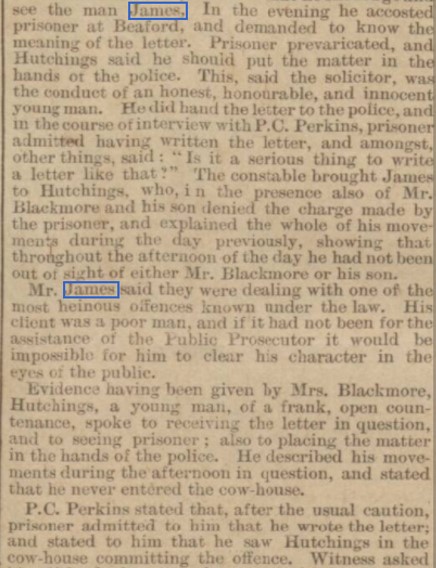
In 1910, Charles was again arrested and this time for a more serious offence. He was found Guilty of sending a threatening letter accusing one James Henry Hutchings of an infamous crime to extort money (eg give me x amount of money or I'll tell the police what I saw), on 15th February 1910, and sentenced to 12 months imprisonment with hard labourer. 

From North Devon Journal of 24th March 1910:


Charles' 1910 Prison record:


The 1911 Census shows Charles, a prisoner in Exeter prison on New North Road.

1911 Census:

In Oct/Nov/Dec 1915, Charles (about 32), rabbit trapper, married Alice Maud Brend (about 26), a domestic maid and housekeeper, in the district of Barnstaple.

Charles and Alice had two children (one son and one daughter):

  • Victor Charles  1920 -
  • Beatrice Hazel Valentine  1922 -
(The name Victor grew in popularity after the victories of WWI. The few Victors I have in my family, great uncles and distant cousins, were born in the 1920's.)

At some point around the 1910s/1920's, Charles and his family moved to Saunton, Braunton, on the North-West coast of Devon, where they would live for many years. Charles' older sister Louisa Tonkin(s) and husband Walter also lived in Braunton for a few years around 1939.

In June 1928, Charles found the body of commercial traveller Henry George Gilbert on Braunton sands, near the lighthouse. Gilbert had been out sailing, there had been some sort of accident, and he had drowned. 

(Somewhat eerily, Charles' nephew Leonard James Tonkin(s) (younger son of Charles' sister Louisa) would also find the body of a drown victim. In 1938, Leonard found the body of of 21-year-old Alfred Channon in the River Otter, at the Honiton Swimming Club Headquarters. In this case, the coroner gave a reluctant verdict of suicide by drowning.)

Charles and Alice's marriage may not have been one made it heaven. Charles put a notice in the North Devon Journal of 16th April 1931 that he would 'not be answerable for any Debts incurred by [his] wife':


However, they still appear together on the 1939 census, and by the time of Alice's death in 1948.

1939 Census:

By the early 1940's, Charles and Alice's young adult daughter Beatrice had married and was living in London - where she would live until her death, aged ninety-two, in 2014. And at some point their son Victor it seems may have moved to live in Scotland. However both children returned to Devon in 1948 to attend their mother's funeral.

In January or February 1948, Charles' wife Alice passed away, aged about 58. Her funeral took place on 19th February 1948 at St Brannock's, Braunton. It was attended by family and friends, including Charles' sister Emily and her husband Sam Trigger, and Charles' brother Francis and his wife.

From the North Devon Journal of 26th February 1948:

In Oct/Nov/Dec 1965, Charles himself passed away, aged eighty-two, in the district of Barnstaple.

Saturday, 2 May 2020

Great x4 Grandmother Loveday Turner (nee Bennett)

My Great x4 Grandmother Loveday (1785 - 1854) was a farm servant, housewife, and mother of ten.


Loveday was born around 1785 in North Tawton, Devon to James Bennett (about 27), and Sarah Bennett (nee Skinner) (about 30).

Loveday was baptised on 20th November 1785 in North Tawton.

Loveday was the fourth of seven daughters:

  • Joanna  1782 -
  • Sarah  1784 - 1784  (about 3 weeks old)
  • Susanna  1784 - 1784  (about 3 weeks old)
  • Loveday  1785 -
  • Dinah  1788 -
  • Mary  1790 -
  • Mahlah  1793 - 1797  (3 or 4 years old)

In 1784, the year before Loveday was born, her older sisters, twins Sarah and Susanna, passed away, only a few weeks old. Together they were baptised on 4th April and buried on 21st April in North Tawton.

In the late 1780's the baptisms of the girls show, the family lived in North Tawton. In the early 1790's, the family moved from North Tawton back to Sampford Courtney, where Loveday's youngest sister, Mahlah was baptised in 1793.

In 1793, when Loveday was about seven, her father James passed away, aged about thirty-five. James was buried on 10th September 1793 in Sampford Courtenay. In the same year, Loveday's widowed mother, Sarah, along with her four youngest daughters, were ordered to be removed from Belstone back to Sampford Courtenay.

In early 1797, when Loveday was about ten, her youngest sister Mahlah passed away, aged about only three or four. Mahlah was buried on 5th February 1797 in Sampford Courtenay.

In 1797, when Loveday was ten or eleven, she was apprenticed to Simon Coombe of Sampford Courtenay.

In 1801, when Loveday was about fifteen, her mother Sarah passed away, aged about forty-six. Sarah was buried on 12th September 1801 in Sampford Courtenay.

In 1805, when Loveday was about nineteen and working as a servant, she gave birth to an illegitimate daughter, fathered by William Coombe. Their daughter was christened Dinah Coombe, on 11th August 1805 in Sampford Courtenay, but would later go by Dinah Bennett. William was ordered by the parish to pay maintenance. William may well have been the young son of Loveday's employer, Simon Coombe. I wonder if Loveday and William's relationship was short-lived and reached its end before Dinah's birth.

On 4th November 1811, Loveday (about 26) married George Turner (about 24), a labourer at Plymouth Dock, in Stoke Damerel, near Plymouth, which is over thirty-miles south of Sampford Courtenay, where Loveday lived for most of her younger years. Whilst George was able to sign his name (interestingly he spelt it without the first e, eg 'Gorge'), Loveday left only her mark, implying she could not write.

'Plymouth [Dock], from Mount Edgcumbe' painted by JMW Turner in the 1810's

Loveday and George have nine children (six daughters and three brothers):

  • Mary  1813 -
  • Loveday  1816 -
  • Rebecca  1818 -
  • Elizabeth  1821 -
  • Susan  1822 - 1826  (3 years old)
  • Eliza  1825 - 1826  (1 year old)
  • George  1827 - 1828  (4 months old)
  • George  1829 -
  • William  1832 -

The baptism records of the couple's eldest five children give the young family's address as Plymouth Dock. Though the couple's first two daughters was baptised into the Church of England; interestingly, when the couple had their third, fourth, and fifth daughters baptised, they chose to have them baptised into the Wesleyan Methodist Church. Does this signify a change in religious belief?

Sometime between 1822 and 1825, the family moved back northwards to Jacobstowe, which is only three miles west of Loveday's former home of Sampford Courtenay. There, the couple's youngest four children were baptised, once more into the Church of England. George continued to work as a labourer, but no longer at the docks - was he now a farm labourer?

In 1826, when Loveday was about forty-one, her infant daughters passed away. Eliza (1 years old) passed away first - she was buried on 30th June - followed by Susan (3 years old) - she was buried, less than a week later, on 6th July - both in Jacobstowe. Touchingly, Loveday's eldest daughter Dinah, who was about one to two months pregnant with her first child at the time, would name that child, a daughter, after the girls: so Loveday's first grandchild was christened Eliza Susan Herd, on 26th February 1827, in Jacobstowe.

Just over one year later, Loveday's son, George, passed away, aged four months old. He was buried on 9th March 1828 in Jacobstowe. George had been Loveday's eighth child, but her first son - I imagine his death was felt acutely. George had likely been named for his father. George and Loveday would named their next born child, another son, George also.

In early 1841, when Loveday was about fifty-five, her husband George passed away, aged about fifty-four. He was buried on 21st February 1841, in Jacobstowe. On his burial record, his abode is listed as Exbourne, which is only one and a half miles from Jacobstowe. He is also described as being a pensioner, implying he was in receipt of a military pension - in other words, a Chelsea pensioner. George would have been a young man at the time of the Napoleonic Wars (1803 - 1815). Had he served in that war, before working as a labourer at Plymouth Dock (today Devonport)? Had he been a sailor? Was it his service that brought him to the navel town in the first place?

Widowed, Loveday lived and worked once more as a servant on farms. Meanwhile her youngest two sons - George, about twelve, and William, about nine - lived and worked as labourers on different farms in the Okehampton area. Whilst her adult daughters had long left home, with at least Dinah, Loveday (junior) and Rebecca married.

The 1841 Census shows Loveday, living with agricultural labourer Thomas Bolt and his family at Bude (Farm), Monkokehampton, which is less than three miles north of Exbourne, where Loveday's husband George had passed away earlier that year.

1841 Census:


Come the 1851 Census, Loveday, now in her mid sixties, is listed as a visitor, living with widow Catherine Piper and her daughters at Folly Gate, Inwardleigh, which is about eight miles south of Loveday's last address in Monkokehampton.

1851 Census:


In 1854, Loveday passed away, aged about sixty-eight, in Inwardleigh. She was buried on 25th June 1854 in Jacobstowe.

Wednesday, 24 April 2019

Great Great Half Uncle Archibald John Weeden Yeo

My Great Great Half Uncle Archibald (1893 - 1899) was the older half brother of my Great Grandfather George 'Len' Leonard Yeo (1902 - 1976).


Archibald was born in Jul/Aug/Sep 1893, in Okehampton, Devon, the illegitimate son of Annie Yeo (25), a domestic servant on a farm.

Archibald was baptised on 15th September 1893 in Okehampton.

Archibald was the third of three illegitimate children born to Annie (two girls and one boy) :


  • Beatrice 'Beattie' Mary Victoria (or Beatrice Florence Victoria)  1885 - 1973 (87 years)
  • Alberta 'Florrie' Florence W  1888 - after 1927  (at least 39 years)
  • Archibald John Wedden  1893 - 1899  (6 years old)


Whilst Florrie's father was one John Worth, a labourer, the father/s of Beattie and Archibald are unknown.

Sadly, Archibald was life was short. In Oct/Nov/Dec 1899, he passed away, aged six, in the district of Exeter. Archibald was buried on 14th December 1899, in North Tawton.

Two years after his death, his mother Annie married. From this marriage, Archibald would have gained five younger half siblings (three half brothers and two half sisters):


  • George 'Len' Leonard Yeo  1902 - 1976  (74 years)
  • Archibald Arthur Yeo  1903 - 1904  (15 - 21 months)
  • Archibald Arthur Yeo  1906 - 1906  (0 - 3 months)
  • Pearl May Yeo  1909 - 1909  (0 - 3 months)
  • Barbara May Yeo  1912 - 1927  (15 years)


Poignantly Annie would name two more sons Archibald. Sadly both died as young babies. Her surviving son Len would name his oldest son Archibald, after his brothers. This Archie would live to see the dawn of the 21st century.

Saturday, 19 January 2019

Great x4 Grandmother Martha Brealey (nee Hill)

My Great x4 Grandmother Martha (1805 - 1837) was a housewife and mother of three.


Martha Hill was born around 1805 in Coldridge, Devon, to George Hill (about 34), a husbandman and labourer, and Elizabeth Hill (nee Steer) (about 28).

Martha was baptised on the 12th May 1805 in Coldridge.

Martha was the fifth of eleven children (five sons and six daughters):


  • John  1797 -
  • Mary  1799 -
  • Betsy  1802 -
  • William  1803 - before 1812 (0 - 9 years old)
  • Martha  1805 -
  • Harriet  1811 -
  • William  1812 -
  • Thomas  1814 - 1823  (9 years old)
  • Susannah  1816 - 1817  (19 weeks old)
  • James  1818 - 1824  (7 years old)
  • Susannah  1819 -


Martha lost four of her siblings young. Her older brother William passed away either before Martha was born or when she was very young.

In 1817, when Martha was about twelve years old, her younger sister Susannah passed away at only nineteen weeks old.

Two years later, in 1819, when Martha was fourteen years old, her father George passed away, aged about forty-eight, leaving behind a widow and ten children.

Another two years later, when Martha was sixteen, her mother Elizabeth remarried. On Christmas Day 1821, Elizabeth (44) married Philip Osborn, in Coldridge.

Around 1822, when Martha was about seventeen, she and her family moved about five miles south west from Coldridge to North Tawton.

In 1823, when Martha was eighteen, her younger brother Thomas passed away, aged only nine years old.

In 1824, when Martha was nineteen, her younger brother James passed away, aged only seven years old.

On 27th June 1830, Martha (25) married Richard (22), a carpenter, in his native North Tawton. Martha was about three months pregnant when they married.

Both were able to sign their name on their record of marriage.

Martha Hill's Signature, 1830

Martha and Richard had three sons:


  • George  1830 -
  • Robert  1833 -
  • Richard  1835 -


In 1837, Martha passed away, aged thirty-two, in North Tawton. She was buried on 2nd December 1837 in North Tawton.

She left behind a widower in Richard and three infant sons - George (6), Robert (4) and Richard (2).

Friday, 18 January 2019

Great x4 Grandfather Richard Knight Brealey

My Great x4 Grandfather Richard (1808 - 1892) was a carpenter, wheelwright, and father of eight.


Richard Knight Brealey was born around 1808, in North Tawton, Devon, to George Brealey (22), a carpenter, and Elizabeth Brealey (nee Knight).

Richard was baptised on 17th January 1808 in North Tawton.

Richard was the fourth of nine children (five daughters and four sons):


  • Betty  1802 -
  • Lucy  1804 -
  • Mary  1806 -
  • Richard Knight  1808 -
  • Ann  1812 -
  • Henry  1814 - 1814 (10 days old)
  • John  1815 -
  • Henry  1818 -
  • Margaret  1820 - 1844 (23 years old)


All nine were baptised in North Tawton.

In 1814, when Richard was six, his younger brother Henry passed away, aged only 10 days old.

On 27th June 1830, Richard (22), a carpenter, married Martha Hill (25), in North Tawton, Devon. Martha was about three months pregnant when they married.

Both were able to sign their name of their record of marriage.

Richard Knight Brealey's Signature

Richard and Martha had three sons:


  • George  1830 -
  • Robert  1833 -
  • Richard  1835 -


In 1837, when Richard was twenty-nine, his wife Martha passed away, aged thirty-two, in North Tawton. Richard was then a young widower, with three infant sons.

Richard soon remarried. On 2nd September 1838, Richard (29) married Ann Hill (about 28) in St Edmund's Church, Exeter. They married in the presence of Ann's father George Hill. Again Richard signed his name, but Ann left only a mark. Though Martha and Ann both had the maiden name Hill, it looked unlikely they were closely related.

At the time of their marriage, both Richard and Ann resided in Edmund Street, Exeter.

Drawing of St Edmund's Church and Edmund Street, Exeter, c 1830's. Richard lived and married here in 1838.

Photograph of St Edmund's Church and Edmund Street, Exeter, c 1860's

Though Richard and Ann married in Exeter, they soon returned to his native North Tawton.

Richard and his second wife Ann had four children:


  • John  1839 - 1845  (5 years old)
  • William  1841 -
  • Martha  1843 - 1845  (2 years old)
  • Henry 'Harry'  1845 -


Richard may have named his daughter Martha after his first wife.

1841 Census:


In 1845, when Richard was thirty-eight, two of his infant children, John and Martha died of measles. Both were buried on 11th May 1845 in North Tawton.

Only two days later, Richard's youngest son Henry was baptised on 13th May 1845. He was born right in the middle of a local measles outbreak that killed two of his older siblings.

Six years later, in 1851, when Richard was forty-four, his second wife Ann passed away, aged forty-four, in North Tawton. She was buried on 6th September 1852, in North Tawton.

In his mid forties, Richard had lost two wives and two young children. He was a single father with five young sons, ranging from five to twenty years old.

1851 Census:


Three years after his second wife Ann's death, Richard married again for a third time. On 26th June 1854, Richard (46) married Agnes Evans (36), in North Tawton.

Richard and Agnes had one daughter:


  • Selina  1856 -


1861 Census:


1871 Census:


1881 Census:


By the late 1880's, Richard's wife Agnes had grown blind.

Tragedy struck Richard and his family in 1889, when Richard was eighty-one years old.

Firstly, Henry 'Harry', Richard's youngest son from his second marriage, was charged with manslaughter, having hit his mistress Elizabeth 'Lizzy' Redway, who fell back, hit her head, and died. He was sentenced to ten days hard labour.

Secondly, William, Richard's second son from his second marriage, who was dying from stomach cancer, in great pain and suffering from depression, killed himself, slitting his throat with a razor.

1891 Census:


Interestingly, by the 1890's, an elderly Richard was able to keep a servant.

Many of Richard's sons followed him into carpentry, becoming carpenters, joiners and wheelwrights. Richard himself worked as a carpenter into his eighties.

In 1892, a about a week or two before his eight-forth birthday, Richard passed away. He was buried on 2nd January 1892 in North Tawton.

Tuesday, 17 July 2018

Great x3 Grandfather George Brealey

My great x3 grandfather George (1830 - 1894) was a carpenter and father of three.


George Brealey was born in 1830 in North Tawton, Devon to Richard Knight Brealey (22), a carpenter, and Martha Brealey (nee Hill) (25).

George was baptised on 12th December 1830 in North Tawton.

George's mother Martha had been about three pregnant with him, when she married George's father Richard.

George was the eldest of three brothers:

  • George  1830 -
  • Robert  1833 -
  • Richard  1835 -

In 1837, when George was six, his mother Martha passed away. aged thirty-two, in North Tawton.

About one year later, when George was seven, his father remarried. On 2nd September 1838, Richard Brealey (29), a carpenter, married Ann Hill (about 28) in St Edmund's Church, Exeter.

1841 Census:


George soon had four younger half siblings from his father's second marriage:

  • John  1839 - 1845 (5 years old)
  • William  1844 -
  • Martha  1843 - 1845 (2 years old)
  • Henry 'Harry'  1845 -

Sadly, in May 1845, when George was fourteen, his younger half siblings John (5 years old) and Martha (2 years old) both died of measles.

Six years later, when George was twenty, his step mother Ann passed away, aged forty-four, in 1851, in North Tawton.

1851 Census:


On 20th July 1853, George (22), a carpenter like his father, married Joanna Sampson (33), in North Tawton.

Around 1854, George and Joanna moved around twenty miles south east to Holy Trinity, Exeter.

Around the same time, George's father Richard married for a third time. On 26th June 1854, Richard (46), a carpenter, married Agnes Even (36), in North Tawton.

George soon gained another younger half sibling:

  • Selina  1856 -

George and Joanna had three children (one son and two daughters):

  • Emma  1855 - 1924  (68 or 69 years old)
  • Charles  1857 - 1923  (65 years old)
  • Eliza  1859 - 1860  (13 months old)

Sadly, in 1860, when George was twenty-nine, his youngest daughter Eliza passed away, aged only thirteen months. She was buried on 25th March 1860, in Holy Trinity, Exeter.

1861 Census:


1871 Census:


In 1872, when George was forty-two, his wife Joanna passed away, aged fifty-three, in Exeter. She was buried on 29th December 1872, in Holy Trinity, Exeter.

Four years later, George remarried. In the summer of 1876, George (45), a carpenter, married Charlotte Mary Filleul (30), a laundress, in Exeter.

1881 Census:


Tragedy struck George and his family in August 1889, when George was fifty-eight years old.

Firstly, Henry 'Harry', George's youngest half brother from his father's second marriage, was charged with manslaughter, having hit his mistress Elizabeth 'Lizzy' Redway, who fell back, hit her head, and died. He was sentenced to ten days hard labourer.

Seondly, William, George's younger half brother from his father's second marriage, who was dying from stomach cancer, in great pain and suffering from depression, killed himself, slitting his throat with a razor. George himself was sent to identify William's body.

George's second wife Charlotte appears to have had a problem with drink. She was repeatedly charged for being drunk and disorderly, and spent many years in a home for inebriate women.

From the Western Times on 10th March 1890:


1891 Census:


In 1894, George passed away, aged sixty-three, in Holy Trinity, Exeter. He was buried on 12th May 1894 in Holy Trinity, Exeter.