Showing posts with label somerset. Show all posts

Thursday, 19 March 2020

Great x4 Grandmother Jane Andrews (nee Perkins)

My Great x4 Grandmother Jane (1820 - after 1901) was a servant, housewife, and mother of ten.


Jane was born around 1820 in the county of Kent (likely Dartford in Kent; else in Shoreditch, London), to Robert Perkins (about 25), a labourer and worker in a London oil mill, and Elizabeth Perkins (nee Cooper) (about 29).

Jane was baptised on 11th February 1821 in Shoreditch, London.

Jane was the third of four children (three sons and one daughter):


  • John  1817 -
  • William  1819 -
  • Jane  1821 -
  • George  1823 -


Jane's parents, Robert and Elizabeth, had married in Dartford, in Kent, on Christmas Eve 1815. Their first two sons, John and William, were born and baptised in Dartford, in 1817 and 1819 respectively. It seems the family then moved to Shoreditch, London, for there Jane was baptised in 1821. Whilst in London, her father Robert worked in oil mills there (his occupation as such is given on his youngest son George's baptism record). Come 1822 and the family were living down in Upton Pyne, Devon. There Robert and Elizabeth were buried, and their youngest son George baptised in 1823.

When Jane was nearly two years old, her father Robert passed away, aged only twenty-seven. He was buried on 27th October 1822 in Upton Pyne. At the time of his death, his wife, Elizabeth, was about two or three months pregnant with their fourth child.

Only eight months after her father passed away, when Jane was about two and a half years old, her mother Elizabeth also passed away, aged about thirty-one. Elizabeth was buried on 29th June 1823 in Upton Pyne. Elizabeth had given birth for the last time only the previous month - might she have passed away as a result of the birth?

All later censuses, taken was Jane was an adult, say she was born in the county of Kent, however no town or village is ever given. Given that her parents died when she was one or two years old, and her brothers were about six years old, four years old and one month old, she may not have known where she was born, but may have been told her family came from Kent.

Upton Pyne, 1823; who was looking after the four little Perkins orphans? Whilst their mother, Elizabeth, may well have been from Kent; it seems their father, Robert, may have been a native of Upton Pyne. A Robert Perkins, son of John and Mary, was baptised there in 1795 (the year according to Robert's burial record he was born). So paternal relations may likely have taken the children in. It also makes sense that Elizabeth would go to her husband's place of birth, around the time of his death, for it would be that parish which would (if any) have a duty to give aid to her and her children, for she and her children, as a man's wife and children, would thus be of his parish. Also, at Jane's wedding in nearby Exeter, nearly two decades later, a James Perkins acts as witness. This James was likely her uncle, her father Robert's younger brother.

Come 1840 and Jane, now a young woman, could be found living in Bartholomew Street, Exeter, working as a servant. On 18th October 1840, Jane (19 or 20) married William Andrews (22), an agricultural labourer, in St Olave, Exeter. At the time, William, though a native of Morchard Bishop, was also residing in Bartholomew Street. On their record of marriage, Jane and William left only their mark, implying neither could write.

It seems Jane was about five months pregnant with the couple's first child, when they married.

Jane and William had ten children (four daughters and six sons):


  • Mary Jane  1841 - 1843 (about 2 years old)
  • John  1844 -
  • Sarah Ann  1847 -
  • George  1851 -
  • James  1854 -
  • Mary Emma  1856 -
  • William J  1859 -
  • Eliza Jane  1861 -
  • Jane  1864 -
  • Elizabeth  1865 -


The couple's oldest child, Mary Jane, was baptised in William's native Morchard Bishop in February 1841, implying the young family moved back there from Exeter around late 1840, early 1841. Sadly Mary Jane seems to have passed away young.

Come the 1841 Census, the family had moved again, about nine miles south-east, from Morchard Bishop to Mills Cottages, Shobrooke, Crediton.

1841 Census:


However, within a few years, they were back down in Exeter. At the time of their son John's baptism in 1844, the family resided in Cowley Road, Exeter.

A few years later, and they had moved again, about four miles north from Exeter to Stoke Canon, where they resided at the time of their daughter Sarah Ann's baptism in 1847. They were still there come the 1851 census.

1851 Census:


Sometime in the early 1850's, Jane and her family moved again, about thirteen miles north-east from Stoke Canon to Sampford Peverell, where the younger children were born and baptised.

Unfortunately I cannot find the family on the 1861 Census; however, baptism records imply the family were still living in Sampford Peverell at the time.

Sometime in the late 1860's, Jane and her family moved once more: this time over the border into Somerset! They moved about fifteen miles north-east from Sampford Peverell to Allerford, Hillfarrance, Somerset. They would remain in the area for twenty/thirty years until their deaths. Lodging with the family was Emma Bennett, the older sister of James Bennett. the husband of Jane's daughter Sarah Ann.

1871 Census:


In August 1872, Jane's daughter Sarah Ann was suddenly widowed, when her husband James passed away as a result of an accident at work. In his role as a packer for the Bristol and Exeter Railway Company, he aimed to unload a truck. Alas he attempted to get into the truck while it was still in motion; he missed his step and his leg got entangled in the wheel!

It seems Jane and William were either unable (or chose not) to support their widowed daughter and two infant grandchildren. Sarah, with no obvious means of support, was left a pauper and sought relief in Exeter. Sadly, she and her children were not welcomed by the city, and its justices sought to have them legally removed to South Molton. But Sarah did soon settle in Exeter, with her second husband, Scottish veteran of the Crimean War, James Clapperton, by whom she had more children.


1881 Census:


On 18th October 1890, Jane and William celebrated their golden wedding anniversary. The local newspaper at the time that the elderly couple had "worked hard all their lives, and brought up a [large] family of children".

From the Weston Mercury of 1st November 1890:


1891 Census:


In January 1894, when Jane was about seventy-three, her husband William passed away, likely just short of his seventy-sixth birthday. He was buried on 21st January 1894 in Hillfarrance, Somerset. Jane, now widowed, moved in with their son, William, a groom, and his young family, in Taunton, Somerset.

1901 Census:


Jane's parents had been born at the end of the 18th century; Jane, in her old age, would live to see the beginning of the 20th century.

Although I cannot find a record of death, it seems likely Jane passed away, in her eighties, in Somerset, in the first decade of the 20th century, as she doesn't appear on the 1911 census.

Great x4 Grandfather William Andrews

My Great x4 Grandfather William (1818 - 1894) was an agricultural and railway labourer, and father of ten.


William was born around 1818 in Morchard Bishop, Devon, to Thomas Andrews (about 29), an agricultural labourer, and Mary Andrews (nee Lee) (about 27).

William was baptised on 8th February 1818 in Morchard Bishop. At the time of his baptism, the family lived in Oldborough (likely Oldborough Cottage) in Morchard Bishop.

William was the fourth of nine children (five sons and four daughters):

  • John  1810 - 1810 (less than a week old)
  • Sarah  1811 -
  • John  1815 - 1818 (3 or 4 years old)
  • William  1818 -
  • Eliza  1820 -
  • John  1823 -
  • David  1825 -
  • Jane Mary  1828 -
  • Charlotte  1832 -

Sadly William's eldest brother John passed away only days old in 1810. He was baptised 3rd April and buried on 8th April 1810 in Morchard Bishop. William's next older brother, also called John, also passed away, aged three or four years old, in 1818. He was buried on 29th December 1818 in Morchard Bishop.

From the baptism records of the younger siblings, we learn the family moved from Oldborough to Frost (likely Frost Cottage), also in Morchard Bishop, in the early 1820's. They were still there, a decade later, in the early 1830's, when William's youngest sister Charlotte was baptised.

As a young man, William found himself, about fifteen miles south-east of his native Morchard Bishop, in Exeter. There he married.

On 18th October 1840, William (22), an agricultural labourer, married Kent-native Jane Perkins (19), a servant, in St Olave, Exeter. At the time of their marriage, both were residents of Bartholomew Street. William and Jane each left only their mark, implying their were illiterate. A James Perkins witnessed the marriage - likely a close relative of Jane.

William and Jane had ten children (four daughters and six sons):


  • Mary Jane  1841 - 1843 (about 2 years old)
  • John  1844 -
  • Sarah Ann  1847 -
  • George  1851 -
  • James  1854 -
  • Mary Emma  1856 -
  • William J  1859 -
  • Eliza Jane  1861 -
  • Jane  1864 -
  • Elizabeth  1865 -


The couple's oldest child, Mary Jane, was baptised in William's native Morchard Bishop, implying the young family moved back there from Exeter around late 1840, early 1841. Sadly Mary Jane passed away aged only about two years old.

Come the 1841 Census, the family had moved again, about nine miles south-east, from Morchard Bishop to Mills Cottages, Shobrooke, Crediton.

1841 Census:


However, within a few years, they were back down in Exeter. At the time of their son John's baptism in 1844, the family resided in Cowley Road, Exeter.

In the 1840's, in his twenties, William changed professions: the agricultural labourer became a railway labourer.

A few years later, and they had moved again, about four north from Exeter to Stoke Canon, where they resided at the time of their daughter Sarah Ann's baptism in 1847. They were still there come the 1851 census.

1851 Census:


Sometime in the early 1850's, William and his family moved again, about thirteen miles north-east from Stoke Canon to Sampford Peverell, where the younger children were born and baptised.

Unfortunately I cannot find the family on the 1861 Census; however, baptism records imply the family were still living in Sampford Peverell at the time.

Sometime in the late 1860's, William and his family moved once more: this time over the border in Somerset! They moved about fifteen miles north-east from Sampford Peverell to Allerford, Hillfarrance, Somerset. They would remain in the area for twenty/thirty years until their deaths. There once more William worked as an agricultural labourer. Lodging with the family was Emma Bennett, the older sister of James Bennett, the husband of William's daughter Sarah Ann.

1871 Census:


In August 1872, William's daughter Sarah Ann was suddenly widowed, when her husband James passed away as a result of an accident at work. In his role as a packer for the Bristol and Exeter Railway Company, he aimed to unload a truck. Alas he attempted to get into the truck while it was still in motion; he missed his step and his leg got entangled in the wheel!

It seems William and Jane were either unable (or chose not) to support their widowed daughter and two infant grandchildren. Sarah, with no obvious means of support, was left a pauper and sought relief in Exeter. Sadly, she and her children were not welcomed by the city, and its justices sought to have them legally removed to South Molton. But Sarah did soon settle in Exeter, with her second husband, Scottish veteran of the Crimean War, James Clapperton, by whom she had more children.

1881 Census:


On 18th October 1890, William and Jane celebrated their golden wedding anniversary. The local newspaper at the time reported that the elderly couple had "worked hard all their lives, and brought up a [large] family of children".

From the Weston Mercury of 1st November 1890:


1891 Census:


William passed away in January 1894, likely just short of his seventy-sixth birthday. He was buried on 21st January 1894 in Hillfarrance, Somerset. His widow, Jane, would move in with their son, William, a groom, and his young family, in Taunton, Somerset.

Thursday, 17 January 2019

Great x4 Grandmother Mary Havill (nee Parker)

My Great x4 Grandmother Mary (1799 - 1875) was a laundress and mother of nine.


Mary Parker was born around 1799 in Wiveliscombe, Somerset, to John Parker, an innkeeper and maltster (about 28), and Betty Parker (nee Hill) (about 24).

Mary was baptised on 12th May 1799 in Wiveliscombe.

Mary was the eldest of seven children (five daughters and two sons):


  • Mary  1799 -
  • James  1802 -
  • Betty  1804 - 1806  (about 18 months)
  • Betty  1806 -
  • Maria  1809 -
  • Jane  1813 -
  • John  1816 -


In 1806, when Mary was about seven, her younger sister Betty passed away, aged only about eighteen months.

Sometime as a girl or young woman, Mary moved about twenty-six miles south from Wiveliscombe to Aylesbeare, Devon.

On 24th March 1822, Mary (22) married John Havill (23), a farm labourer, in Aylesbeare. On their record of marriage, neither could sign their name.

Also in 1822, Mary's mother Betty passed away, aged about forty-seven, in Wiveliscombe. She was buried on 6th September 1822.

Mary and John had nine children (five sons and four daughters):


  • Jane  1822 -
  • Anna Maria  1826 -
  • Elizabeth  1829 - 1829 (about one week old)
  • George  1830 -
  • James  1833 -
  • William  1836 -
  • Robert  1838 -
  • Henry  1840 -
  • Elizabeth  1843 -


In 1829, when Mary was about thirty, her third daughter, Elizabeth, passed away, aged about only one week, in Aylesbeare.

1841 Census:


1851 Census:


1861 Census:


The Censuses show Mary and John took in Thomas, the illegitimate son of their eldest daughter Jane, and Walter, the illegitimate son of their youngest daughter Elizabeth.

On 1st November 1870, when Mary was seventy-three, her husband John passed away, aged seventy-two, in Exeter Hospital. His death was the result of a road accident. He fell off a wagon that turned a tight corner too quickly. He was buried on 9th November 1870, in Aylesbeare. After her husband's death, Mary moved in with her youngest daughter Elizabeth and her family.

1871 Census:


In 1875, Mary herself passed away, aged seventy-six, in Aylesbeare. She was buried on 13th May 1875, in Aylesbeare.

Saturday, 29 September 2018

Great x3 Grandmother Sarah Ann Coulman (formerly Luscombe; formerly Clapperton; formerly Bennett; nee Andrews)

My Great x3 Grandmother Sarah Ann (1847 - 1934) was a landlady, housewife, monthly nurse, mother of ten, and step-mother of five.


Sarah Ann Andrews are born around 1847 in Stoke Canon, Devon, to William Andrews (about 29), a railway and agricultural labourer, and Kent-native Jane Andrews (nee Perkins) (about 26).

Sarah Ann was baptised on 18th April 1847 in Stoke Canon.

Sarah Ann was the third of ten children (four sons and six daughters):

  • Mary Jane 1841 - 1843 (about 2 years old)
  • John  1844 -
  • Sarah Ann  1847 -
  • George  1851 -
  • James  1854 -
  • Mary E  1857 -
  • William  1859 -
  • Eliza Jane  1861 -
  • Jane  1864 -
  • Elizabeth 1865 -

1851 Census:


Sometime in the early 1850s, when Sarah Ann was a young girl, she and her family moved about thirteen miles north-east from her native Stoke Canon to Sampford Peverell, where most of her younger siblings were born and baptised.

Sarah Ann lived and worked away from home from a young age. The 1861 Census shows Sarah Ann, aged about only thirteen, working as a domestic servant for the Drewe family, headed by blacksmith Richard Drewe, in Cullompton, which is about half way between her native Stoke Canon and her family's new home of Sampford Peverell.

1861 Census:


On Christmas Day 1864, Sarah Ann married James Bennett (22), a railway labourer, in Heavitree, near Exeter. Whilst Sarah Ann was able to sign her name on their marriage certificate, James left only his mark, implying he could not write.

Sarah Ann's Signature on her 1864 Marriage Certificate

Sarah Ann gave her age as twenty, when she married. Whilst early records (her baptism, the 1851 and 1861 Censuses) imply Sarah Ann was born around 1847, so in fact nearer to seventeen when she married, later records (her marriage, the 1871 and 1891 Censuses) imply Sarah Ann was born around 1844, making her twenty at the time of her marriage.

Sarah and James had two children:

  • William  1868 - 1942 (73 years old)
  • Emma  1871 - 1944 (73 yeas old)

The young couple moved about five miles south-east from Heavitree to Ebford, where their eldest child William was born in 1868. Did Sarah Ann name her son after her father?

James worked as a labourer and packer for the railway. It seems likely his work took the young Devonian family just over the boarder to Somerset, where daughter Emma was born in 1871. Sarah Ann's parents and young siblings also moved to Somerset, possibly also following work - Sarah Ann's father William also worked as a railway labourer. Did Sarah Ann's father and husband work together?

1871 Census:


At the time of the 1871 Census, Sarah Ann and James were yet to decide a name for their newborn daughter, but soon decided on Emma, perhaps after James' older sister. Sarah Ann's kid sister Eliza stayed with the family at the time.

On Monday 19th August 1872, James' life was cut tragically short. He passed away, aged thirty, from injuries received in an accident at work. In his role as a packer for the Bristol and Exeter Railway Company, he aimed to unload a truck. Alas he attempted to get into the truck while it was still in motion; he missed his step and his leg got entangled in the wheel!

From the Western Gazzette on 23rd August 1872:


James' sudden death left Sarah Ann a widow, with two infant children, and with no obvious means of support. Her parents and younger siblings were only about three miles away in Hillfarrance, Somerset, but with her father being only an agricultural labourer and with other younger children to support, perhaps he couldn't afford to help Sarah Ann much. Left a pauper, Sarah Ann sought relief in Exeter. Sadly, Sarah Ann and her children were not welcomed by the city, and its justices sought to have them legally removed to South Molton.

Around August 1873, Sarah Ann conceived a son, born around May 1874. Around the time she sort relief, she would have been around eight months pregnant. Who was the father?

From the Western Daily Mercury on 2nd April 1874:


Census records imply Sarah Ann soon remarried, and her young children gained a step-father in the form of Scottish veteran of the Crimean War James Clapperton. Yet it should be noted that I cannot find a record of marriage between Sarah Ann and James Clapperton, though they would live for years as husband and wife. We assume James junior was the son of James Clapperton, though no birth or baptism record for James junior can be found, which is not rare if a child is illegitimate.

The family of Sarah Ann, her two infants, and her new husband did settle in Exeter.

Sarah Ann and James would have eight children (four sons and four daughters):

  • James 1874 - 1936  (61)
  • George Henry  1876 - 1952  (75)
  • Albert 1878 - 1878 (2 months)
  • Walter John  1880 - 1913  (32)
  • Lily/Lilian Maude  1882 - 1958 (75)
  • Minnie  1884 - 1956 (71)
  • Ada  1886 - 1888  (1 year and 9 months)
  • Florence 'Florrie' Mabel  1889 - 1975 (85) 

From around December 1877, Sarah Ann and James had lodgers at their home in Little Clifton Street in Exeter. Their lodgers were a couple, Samuel Ford, a cabdriver, and his unwell wife Dinah Ford. Dinah was in hospital for some months, then cared for at Little Clifton Street by Samuel's mother and Sarah Ann, who must have meanwhile been caring too for her four young children. In December 1878, Dinah passed away, with Sarah Ann as witness.

By 1881, also living with the Clapperton/Bennett family were the Miller family: Sarah Ann's younger sister Eliza, now married to American Henry Miller, a fellow pensioner and porter of James, and their baby daughter Mary Jane, Sarah Ann's niece.

I like to think Sarah Ann and Eliza were close, with Eliza living with her older sister on the 1871 and 1881 Censuses.

1881 Census:


Alas Sarah Ann's son James, around the age of eleven, turned to stealing. And not being a fast runner, he was twice caught. On 31st August 1885, James, 11, acted as watch-out, as his younger friend Charles Henry Green, 9, stole threepenny worth of sweets from a shop at 54 Richmond Road, the property of a Miss Osborn. Their crime was witnessed by a William Kerslake, who subsequently caught James. Charles said James, the older lad, had told him to steal the sweets. Only a week later, on 7th September 1885, James attempted another steal with Charles, and another lad, Frederick Charles Hookaway, 10. They stole 50 prawns, worth 1s 6d, from a fish shop at 15 Paris Street, the property of  a Mrs Smith. She ran after the boys down the street and once more James was caught. He was sentenced to three weeks in prision, to be followed by five years in a Reformatory School.

Sometime between 1885 and 1888, Sarah Ann and the rest of her family moved from Little Clifton Street to New Cheeke Street, also in Exeter. Sarah Ann's young niece Mary Jane Miller stayed with the family.

Sarah was the friend that Emily Robins always turned to when she needed support. An 1885 article details how it was always to Sarah's home that Emily ran for shelter from her husband, Hugh's violence. Emily's husband deserted her the following year, and the year after that her teenage son Edward died, along with many others, when Exeter's theatre burnt down. I hope Emily and Sarah were able to support each other through all their troubles.

Tragedy struck Sarah Ann again in 1888: as an accident involving a lorry killed her first husband, so an accident involving a tram killed her daughter. On the evening of 11th April 1888, Ada was only a toddler, out of her mother's sight for barely a minute while she fetched water from the house next door, and watched over by an older brother (George, 11); but in a passing moment a younger brother (Walter, 8) left the front door open and little Ada ran out, and just when a tram came pass. The tram-driver braked suddenly, but too late. The elder brother, oh how racked with guilt and shock and sadness he must have been, when he then ran to his mother to tell her. 

From the Western Times on 17th April 1888:


1891 Census:


Sarah Ann's became a military family... 

Her second husband James served in the Crimean War, all four of her sons served in the Boer War, and many of her grandchildren and great grandchildren served in the the First World War and Second World War...

Her second husband James was dismissed from the army, being found no longer fit to serve, on 26th June 1874, after nineteen years service, and having risen to the rank of Sergeant. Due to exposure to the sun in India, James was suffering from amaurosis (a painless temporary loss of vision in both of his eyes).

His record of dismissal gives a brief description of James' character and physical appearance...

Such was written of his character: "Conduct has been very good... [he is] in possession of four good conduct badges... [however] his name appears five times in the Regimental Defaulters' Book [and] he has been twice tried by Court Martial". 

Such was written of his physical appearance: he was 5'10'', had a fresh complexion, blue eyes and light hair. His colouring was quite viking it seems.

He had left his wool-spinning family in their native Galashiels, just over the Scottish boarder, and signed up as a private on 31st January 1855, aged nineteen; he now left the army, aged thirty-eight, a Sergeant, having spent half his life, and essentially all his adult life thus far in the army. It seems there was a change of plan: his initial intended place of residence after leaving the army is crossed out and a street in Exeter written in its place. In April 1874, Sarah Ann was being denied relief in Exeter; James junior's later army service records imply he was born around May 1874; and in June 1874, James senior was dismissed from the army and settled in Exeter likely to join Sarah Ann and his son.

I imagine James inspired or encouraged his step-son and sons to later serve. Sarah Ann's eldest child, her son from her first marriage, William, served for thirteen years. Aged twenty, he joined the Duke of Cornwall's Light Infantry as a private on 27th July 1889. Like his step-father before him, he served in India. He served in India for four years from 26th November 1892 to 14th February 1897, and then again for another year from 3rd August 1899 to 21st December 1900. Finally he served in Ceylon from 22nd December 1900 to 21st July 1902. William did not resemble in step-father in appearance: he had sallow skin, grey eyes, brown hair, and was only 5'3 1/2''. Did he look like Sarah Ann? Did he look like his father, Sarah Ann's first husband James Bennett? Did he remind her of him?

Sarah Ann's next son, James, the one who stole the sweets and prawns as a boy, also served. He served in both the Boer War and the First World War. Unfortunately I cannot find his service record for the Boer War, but his service record from the First World War gives us some information of his previous service. It informs us he served in the Devonshire Regiment for ten years, leaving around 1903, meaning he must have joined around 1893, aged about nineteen. James, who rose to the rank of Sergeant like his father before him, reenlisted on 19th November 1915, aged forty-one, as a Sapper and Line Telegraphist. He then served in the Royal Engineers on the British Eastern Front from 29th May 1916 to 14th December 1916. He was discharged on 28th May 1917, suffering from gas poisoning. His conduct in the war was described as "very satisfactory" and his character "very good". In appearance, James seems less the viking Clapperton and more perhaps like his mother Sarah Ann: he had a fresh complexion, hazel eyes, dark brown hair, and was 5'4''.

Sarah's third son, George, followed his older brother James into the Devonshire Regiment, in which he served as a private for seven years. He enlisted on 11th March 1896, aged nineteen. George served in the East Indies from 28th February 1898 to 20th September 1899, and in South Africa from 21st September 1899 to 21st May 1903. It seems George resembled his father: he had fresh skin, blue eyes, fair hair, and was 5'5 1/2''.

Sarah's fourth and youngest son, Walter, served as a private in the Royal Marines Light Infantry: Plymouth Division for thirteen years, from 1898 to 1911. Walter enlisted on 28th December 1898, aged eighteen. The fair Clapperton colouring came through: Walter had blue eyes, light brown hair and was 5'8''. His general character was found to be "good". Walter served on many ships, before being invalided out on 16th November 1911. Eighteen months later, he passed away, aged only thirty-two, in April 1913.

Back to the 1890's... 

In early 1894, Sarah Ann's father William passed away, aged seventy-five, at his home in Hillfarrance, Somerset. There he was buried on 21st January 1894.

Sarah and James' relationship of twenty-six years (since 1873) came to a bitter end in 1898/1899. 

They were living separately from around February 1898 "on account of his cruelty to her". He resided on Silver Lane, and Sarah back on Clifton Street. 

On the night of Monday 24th April 1899, "he came to her house and knocked at the door but she did not let him in. He threatened to kill her."

The next day, on the afternoon of Tuesday 25th April 1899, "she met him in the street. He followed her home and when he got into the house struck her several times in the mouth, cutting her lip and loosening her teeth"

From the Western Times on 27th April 1899:


Following the assault, James 'took the pledge' to no longer drink alcohol. 

There are two very different tellings of what would then go on to happen a week later on Monday 1st May 1899.


Sarah's story:

At around 11:30am, on Monday 1st May 1899,  a drunk James came again to Sarah's house and demanded to be admitted. She refused and he forced the door. He lay on the sofa and said he would stay as long as he liked. He then commenced to damage articles of furniture, including tearing curtains and curtain pole from the window. 

After some time, he went to an adjoining house to get some beer. Around 5 - 6pm, James and Sarah's lodger, William 'Billy' Duckham Luscombe, had some more beer between them. 

Suddenly, James rose and struck Sarah, slapping her in the face. Billy "interfered, and, in the struggle, James fell over a chair or caught his foot in the carpet, and got a black eye". James got up again and threatened them both with a knife. 

Sarah and Billy left the house. James bolted the door from the inside, and went to bed, remaining all night in Sarah's home. Sarah came back, but finding the door locked, had to "stop out all night".

Sarah wanted James to stay away from her.


James's story:

James went to Sarah's house on Monday, because he was told on Sunday that she had two men in the house, to which he objected. "He did not think it fair that he should be locked out and the other two men should be let in". Sarah let him in and informed him that she had one lodger. James waited for the lodger, whom he did not know.

Around 5pm, Billy came home. James objected to Billy sleeping there that night. Billy then "commenced to pommel him, giving him a black eye", whilst Sarah said "That's right. Give it to him".

James did not threaten them with a knife.

The beer was purchased after the assault, and James just touched the quart of beer given to him by Billy.

Sarah slipped out of the house, and Billy followed. Sarah had the house key. James, left alone, bolted the door and went to bed.

From the Express and Echo of 3rd May 1899:


And from the Exeter Flying Post on 6th May 1899:


James was subsequently sentenced to a fortnight's imprisonment with hard labour, for breaking the peace. 

The Bench "considered it quite clear the husband [James] had no business there with his wife [Sarah] at all". 

The chairman said "that the Bench desired him to caution her [Sarah] as to her conduct in the future. They had their fears that she had been the means of bringing the poor man [James] his trouble. He had no right to assault her, but they thought that her conduct was largely responsible for it." 

Sarah replied. She said "her husband never gave her any money, and she was bound to do something". What was that something? Taking on lodgers to pay the rent?

I do wonder what is so wrong about Sarah's conduct in all this. Was it simply living separately from her 'husband' and having a male lodger?

Or was it clear to the court then that Sarah and Billy were in a relationship? Certainly by November that year they are calling themselves Mr and Mrs Luscombe, though not legally married.

James would come knocking on Sarah's door again...

On Monday 6th November 1899, James went to Sarah's new home - 32 Russell Street. 

She and Billy rented rooms as Mr and Mrs Luscombe at the home of Frederick and Jane Sommerville (though articles about this incident spell it as Summerwell), both in their seventies. The newspaper says James asked for 'Clara', but I think someone must have misheard Sarah - still they established he meant Mrs Luscombe. 

Jane informed him that 'Clara' was not in. James swore, said she was and called Jane disgusting names. He entered the kitchen, but Jane ordered him out. James then wanted to get her husband Frederick out to drink, but Jane prevented him - James then knocked her down in the passage. He abused her and threatened to assault her again.

Eventually James went outside and Jane locked the door, but James broke it open. A policeman arrived and James went away. Later that evening, James met Jane in the street and knocked her down again.

James returned to the house the next day, on Tuesday 7th November 1899 and offered Jane a sovereign to make it up and added there was "plenty of drink down at Mrs Bennett's". Jane refused his money and put on her bonnet to go get a policeman. James threatened her and struck her a severe blow in the chest. 

Jane left to get a warrant from the Police Station, and on her return found her husband Frederick, who was already partially paralysed, had been seriously assaulted. In her absence, James had returned to the house, thrust Frederick against a wall, pinning him there for three or four minutes and striking him several blows in the face, blacking both eyes.

James was very sorry for assaulting the couple. He was sentenced to four months imprisonment. 

Bless, poor Jane would passed away from suicide, only five months later, in April 1900. Frederick, bless him, was the one to find her, hanging by a piece of old rope in the outhouse.

From the Express and Echo of 11th November 1899:


1901 Census:
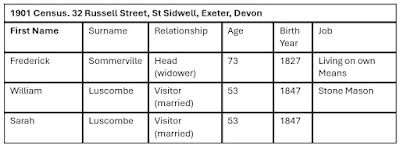

In Jul/Aug/Sep 1903, Sarah (56) married Billy (56), a stone mason, in Exeter.

On 10th May 1909, when Sarah was about sixty-two, Billy passed away, aged sixty-one, in Exeter. He was buried on 15th April 1909 in St Matthew, Exeter.

A widow once more, in her sixties, Sarah worked as a monthly nurse (a woman who would help care for a mother and child the first month or so after the birth).

1911 Census:


By time of the 1921 Census, Sarah was already living with her future husband William Andrew Hooper Coulman.

1921 Census:


In Jan/Feb/Mar 1926, Sarah (78), a monthly nurse, married widower William (65), a stone mason, in Exeter.

William was born in Dawlish, but had his first family his Torquay. He had been married to Lavinia Ann Lanyon, who passed away aged forty. She was buried on 3rd August 1895 in Torquay.

In marrying William, Sarah gained five step sons:
  • William Andrew/Henry Hooper  1881 - 1925  (44)
  • John Henry Hooper 1883
  • Charles Edward  1886
  • George Thomas Hooper 1887 - 1888 (1)
  • James Henry  1890
Sarah's eldest step-son William (5506) served as a private in the First World War. 

Sarah and William were both married four times. 

William was widowed four times. His first wife Lavinia passed away in 1895. In 1898, he then married Elizabeth Melhuish, in Newton Abbot. She passed away a year into their marriage, in 1899, in Newton Abbot. He then married Matilda Brout in 1901. She passed away in 1908 in St Thomas, Exeter.

Sarah didn't actually marry her second husband (I cannot find a record of marriage) but lived with him as his wife and took his name. And she moved in with her third and fourth husbands a good few years before she married each - again living as their wife and taking their name. A very unusual approach. As she did it multiple times, I am led to wonder it was her choice. Not being legally married to James Clapperton may have given her more freedom to leave him.

On 26th October 1934, Sarah passed away. aged eighty-seven, in Exeter. She is buried in the Higher Cemetery in Exeter.

Sarah's grave

I am grateful for my second half-cousin twice removed, Robert Slack (grandson of Sarah Ann's youngest daughter Florence), for posting about Sarah's later life. I had struggled to find anything about her after 1899 and was glad to discover she got away from her abusive husband.

Sarah's fourth husband, William, passed away on 11th December 1940, aged eighty, in Exeter.

Tuesday, 10 July 2018

Great Great Grandmother Emma Wright (nee Bennett)

My Great Great Grandmother Emma (1871 - 1944) was a domestic servant, housewife, and mother of twelve.


Emma Bennett was born on 11th February 1871, just over the border in Nynehead, Somerset to Devonian parents, James Bennett (about 29), a railway labourer, and Sarah Ann Bennett (nee Andrews) (about 27). Did James' work for the railway take them into Somerset?

Emma was the second of two children (one son and one daughter):

  • William  1868 - 1942 (73)
  • Emma  1871 - 1944 (73)

When the 1871 Census was taken, 3 weeks old Emma was yet to be named by her parents:


In August 1872, when Emma was just one year old, her father James Bennett, aged about thirty, died from injuries received in an accident at work. In his role as a packer for the Bristol and Exeter Railway Company, he aimed to unload a truck. Alas he attempted to get into the truck while it was still in motion; he missed his step and his leg got entangled in the wheel!

From the Western Gazzette on 23rd August 1872:


Emma's young widowed mother Sarah Ann, left a pauper with two young infants, sought relief in Exeter, Devon. Sadly, they were not welcomed by the city, and its justices sought to have them legally removed to South Molton.

From the Western Daily Mercury on 2nd April 1874:


Census records imply Sarah Ann soon remarried, and Emma and her brother William gained a step-father in the form of Scottish veteran of the Crimean War James Clapperton. Yet it should be noted that I cannot find a record of marriage between Sarah Ann and James Clapperton, though they would live for years as husband and wife.

The family of Sarah Ann, her two infants, and her new husband did settle in Exeter; and Emma and William gained eight younger half siblings (four brothers and four sisters):

  • James 1874 - 1936  (61)
  • George Henry  1876 - 1952  (75)
  • Albert 1878 - 1878 (2 months)
  • Walter John  1880 - 1913  (32)
  • Lily/Lilian Maude  1882 - 1958 (75)
  • Minnie  1884 - 1956 (71)
  • Ada  1886 - 1888  (1 year and 9 months)
  • Florence 'Florrie' Mabel  1889 - 1975 (85)

In 1881, also living or staying with the Clapperton/Bennett family were the Miller family: Emma's uncle by marriage American Henry Miller, a fellow pensioner and porter of James Clapperton; his young wife Eliza, who was Sarah Ann's younger sister and Emma's aunt; and their baby daughter Mary Jane, who was Emma's young cousin.

1881 Census:


When Emma was about fourteen, her younger half brother James, around the age of eleven, alas turned to stealing. And not being a fast runner, he was twice caught. On 31st August 1885, James, 11, acted as watch-out, as his young friend Charles Henry Green, 9, stole threepenny worth of sweets from a shop at 54 Richmond Road, the property of a Miss Osborn. Their crime was witnessed by a William Kerslake, who subsequently caught James. Charles said James, the older lad, had told him to steal the sweets. Only a week later, on 7th September 1885, James attempted another steal with Charles, and another lad, Frederick Charles Hookaway, 10. They stole 50 prawns, worth 1s 6d, from a fish shop at 15 Paris Street, the property of a Mrs Smith. She ran after the boys down the street and once more James was caught. He was sentence to three weeks in prison, to be followed by five years in a Reformatory School.

Sometime between 1885 and 1888, Emma and her family moved from Little Clifton Street to New Cheeke Street, also in Exeter. Young Mary Jane Miller stayed with the family. Were Emma and her cousin Mary Jane friendly? Did Emma get on with her younger half siblings? Did she help look after them?

Tragedy struck seventeen-year-old Emma and her family in 1888: as an accident involving a lorry killed her father, so an accident involving a tram killed her younger half sister, Ada. On the evening of 11th April 1888, Ada was only a toddler, out of her mother, Sarah Ann's sight for barely a minute while she fetched water from the house next door, and watched over by an older brother; but in a passing moment a younger brother left the front door open and little Ada wandered out, just when the older brother wasn't looking, and just when a tram came pass. The tram-driver braked suddenly, but too late. The elder brother, oh how racked with guilt and shock and sadness he must have been, when he then ran to his mother to tell her. The sons in the article aren't named. Was the younger brother Walter, aged about eight, going out onto the street to play with friends? The older brother James, aged about fourteen, maybe, or George, aged about twelve, running to tell poor Sarah Ann?

From the Western Times on 17th April 1888:


1891 Census:


Emma's was a military family. Her step-father James, older brother William, her younger half brothers, and her son George all served in the army...

Emma's older brother William, aged twenty, joined the Duke of Cornwall's Light Infantry as a private on 27th July 1889. He served in India for four years from 26th November 1892 to 14th February 1897, and then again from another year from 3rd August 1899 to 21st December 1900. Finally he served in Ceylon from 22nd December 1900 to 21st July 1902. William's Army Service Record gives a physical description of him as a young man: he had sallow skin, grey eyes, brown hair, and was only 5' 3 1/2''. Did Emma have similar colouring to her brother?

Emma's younger half brother James, the one who stole the sweets and prawns as a boy, served in both the Boer and First World War. Unfortunately I cannot find his service record for the Boer War, but his service record from the First World War gives us some information of his previous service. It informs us he served in the Devonshire Regiment for ten years, leaving around 1903, meaning he must have joined around 1893, aged about nineteen. James, who rose the rank of Sergeant like his father before him, reenlisted on 19th November 1915, aged forty-one, as a Sapper and Line Telegraphist. He then served in the Royal Engineers on the British Eastern Front from 29th May 1916 to 14th December 1916. He was discharged on 28th May 1917, suffering from gas poisoning. His conduct in the war was described as "very satisfactory" and his character "very good". In appearance, James seems less the viking Clapperton and more perhaps like his mother Sarah Ann: he had a fresh complexion, hazel eyes, dark brown hair, and was 5'4''.

Emma's younger half brother George also joined the army. On 11th March 1896, George, aged nineteen, joined the Devonshire Regiment as a private. George served in the East Indies from 28th February 1898 to 20th September 1899, and in South Africa from 21st September 1899 to 21st May 1903. Again George's Army Service Record gives a physical description of him as a young man: in contrast to his older half brother William, George had fresh skin, blue eyes, fair hair, and was 5' 5 1/2''. His colouring was very much like his father.

Emma's youngest half brother Walter, served as a private in the Royal Marines Light Infantry: Plymouth Division for thirteen years, from 1898 to 1911. Walter enlisted on 28th December 1898, aged eighteen. The fair Clapperton colour came through: Walter had blue eyes, light brown hair and was 5'8''. His general character was found to be "good".

In Jul/Aug/Sep 1891, Emma (20), a domestic servant, married Francis 'Frank' George Wright (22), a tinman, in Exeter.

Emma and Frank had twelve children (eight sons, two daughters, and two unknown):

  • Francis 'Will' William  1891 - 1967 (76)
  • George Charles  1893 - 1918 (25)
  • Unnamed Stillborn Child  1894 - 1894 (0)
  • Unnamed Stillborn Child  1895 - 1895 (0)
  • Charles Arthur  1897 - 1897 (5 weeks old)
  • Thomas 'Tom' Edwin  1898 - 1977 (78/79)
  • Walter Henry  1900 - 1986 (85/86)
  • Ernest 'Len' Leonard  1905 - 1981 (76)
  • Samuel 'Sam' John  1908 - 1977 (68)
  • Florence 'Florrie' Ellen  1910 - 1999 (88)
  • Doris May  1912 - 1991 (79)
  • Harold Reginald  1914 - 1985 (70)

Alas, Emma gave birth to two stillborn children, after one another, in 1894 and then 1895. Emma and Frank paid 5s for each child to be buried at Exeter Cemetery. Her next born, a son, was born alive. Sadly, baby Charles, would pass away at only five weeks old, in 1897.

I wonder if Emma's oldest son was named for his father, Frank, and for Emma's brother William. Might Emma's children George, Walter and Florence also have been named after her younger half siblings? Notably, the name James, the name of her father, step-father, and step-brother is not used.

In the 1890s, Emma's husband, Frank, alternated between working as a tinman/tinplate worker and plumber.

Originally Emma and Frank set up home with or near Frank's family in Prospect Place in Exeter's poor West Quarter; however, in late 1892/early 1893, they moved from Prospet Place to 5 Mermaid Lodge, also in Exeter's West Quarter. Yet, by early 1897, they were back living at 10 Prospect Place. Around 1899/1900, the family moved again to nearby 6 Teigh Place, another small court off Rack Street. The 1901 Census shows Frank's elderly widowed mother Sarah lived only two doors down at 4 Teigh Place, and Emma's step father James lived with the family.

The marriage between Emma's mother Sarah Ann and her stepfather James had broken down, with James being violent toward Sarah Ann. Emma and her half siblings seem to stick with James: he lodges with Emma around 1901, and his reported funeral in 1907 is highly attended by family.

From the Western Times on 27th April 1899:


1901 Census:


In April 1906, Emma's younger half sister Florrie, 17, having been out on a Sunday evening with her friends Alice Crocker, 18, and Emma Batchford, 17, they were summoned for having used obscene language. Said a policeman: "They were behaving in a disorderly manner, and their screaming could be heard at a great distance. They pushed against people, and opposite the Guildhall they surrounded some soldiers, who swore at them." Florrie, like her brother James, proved not a fast runner: when the policeman spoke to them and they ran away, Florrie was the one caught. Each was fined 2s 6d.

On 18th January 1907, Emma's step father James passed away, aged seventy-one, in Exeter. His death was reported in the Western Times on 23rd January 1907:


Emma and the family attended his funeral on 24th January 1907 at Exeter's Higher Cemetery. Owing to his military service, his funeral was highly attended and reported in the Western Times on 25th January 1907:


Emma and her family remained at 6 Teigh Place, as seen in the 1911 Census:


Around 1912, some fifteen to twenty years before the clearing of the poor West Quarter, Emma and her family moved from the area to nearby 11 Clinton Street, Exeter.

In 1913, when Emma was forty-two, her younger half brother Walter passed away. In the Royal Marines for thirteen years, Walter had served on many ships, before being invalided out on 16th November 1911. Eighteen months later, he passed away, aged thirty-two, in April 1913.

His death was reported in the Western Times on 8th April 1913:


Emma's second son George served in the First World War. After four years in the Territorial Royal Army Medical Corps, George, aged twenty-one, joined the 7th Reserve (Cyclist) Battalion of the Devonshire Regiment as a private, on 17th December 1914. George passed away, aged twenty-five, in March 1918, in Exeter, when his mother Emma was forty-seven.

My father recalls being told that an uncle of his mother, Delma, struggled after his experience in the First World War, and lived in a shed in the bottom of the garden, and wouldn't go in the house. Emma's son George seems to be the only uncle of Delma who served in the First World War, so it seems likely that my father's story is alas about him.

Photograph of Emma and Frank in middle aged, c 1920

On 17th October 1937, Emma's 19-year-old grandson Phillip (son of Emma's eldest son Will) passed away. The young man had been in a motor bike accident on 23rd June. He lay unconscious in hospital for three weeks, but appeared to gradually improve and was discharged and returned home to the care of his paternal grandmother (Emma) on 6th August. Then on the morning of the 16th October, he suddenly took a turn for the worse, complaining of pains in his head and feeling giddy. He was readmitted to the hospital that evening unconscious. He passed away on the evening of the 17th. A post-mortem revealed the cause of death to be meningitis following fracture of the skull. 

Phillip had been brought up by his grandmother - his mother Lina having passed away, when he was a baby; and his father Will, according to a 1939 newspaper report, was living and working in Canada. However, by 1939, Will was back living in the Wright family home in Clinton Street, Exeter.

...

Like father, like son: as Emma's stepfather James abused his wife and Emma's mother Sarah, alas so did Emma's younger half brother James abuse his wife Elizabeth. Throughout the 1920's and 1930's, he was repeatedly charged: with abusing his wife, with being drunk and disorderly, with stealing, with failing to pay maintenance to his wife, later separated from him, for the care of their ten children. He seems have been a bad egg. Talking about eggs, he stole four hens eggs in 1930 and was caught. Part of him was ever the boy stealing - be it a handful of sweets or prawns or eggs - and ever getting caught; part of him was the man of the military, like his father, his violence let out on his wife.

Emma's husband Frank thankfully seem seems to have been a nice man. Frank would not live to see the Second World War. He passed away in January or February 1939, aged seventy, at their home of 11 Clinton Street, Exeter. Emma would have been nearly sixty-eight. After his death, Emma and her family posted this in the Express and Echo on 13th February 1939:


Who Frank Left Behind: The Wright Family, c 1940

Stood from left to right: Walter, Doris, Florrie and Harold

Sat from left to right: Sam, Tom, Emma, Will and Len

At the outbreak of the Second World War in September 1939, Emma could still be found living at her home of 11 Clinton Street in Exeter, with her sons Will and Sam, and her older brother William.

1939 Census:


In Jan/Feb/Mar 1942, when Emma was seventy or seventy-one, her older brother William passed away, aged seventy-three, in Exeter.

Alas Emma also did not live to see the Second World War end. She passed away, aged seventy-three, in Oct/Nov/Dec 1944, in adoptive home of Exeter.