Showing posts with label Heavitree. Show all posts

Saturday, 4 April 2020

Great x4 Grandmother Mary Ireland (nee Riggs)

My Great x4 Grandmother Mary (1814 - 1883) was a servant, laundress, housewife, and mother of four.


Mary was born around 1814 in Ivybridge, Devon, to Robert Riggs (about 35), a labourer, and Irish-born Mary Anne Riggs (nee Gibson) (about 29).

Mary was baptised on 8th October 1814 in Harford (a hamlet two miles north of the town of Ivybridge).

Mary was the fourth of eight children (five sons and three daughters):

  • John Robert  1805 -
  • Anne  1807 -
  • Robert  1810 -
  • Mary  1814 -
  • Thomas  1817 -
  • James 1820 -
  • Jane  1822 -
  • Charles  1825 -

All eight children seem to have survived into adulthood. The five eldest siblings were baptised in Harford. Sometime between 1817 and 1820, the Riggs family must have made the approximately forty mile move north-east from the Ivybridge/Harford area to Farringdon, for there the three younger siblings were baptised in the early 1820's. In making this move, the family moved back nearer to Mary's father Robert's hometown - Robert was born in Ottery St Mary, which is only about seven miles north-east of Farringdon.

In 1834, when Mary was about nineteen, she give birth to an illegitimate son, John. John was baptised on 2nd March 1834 in Farringdon.

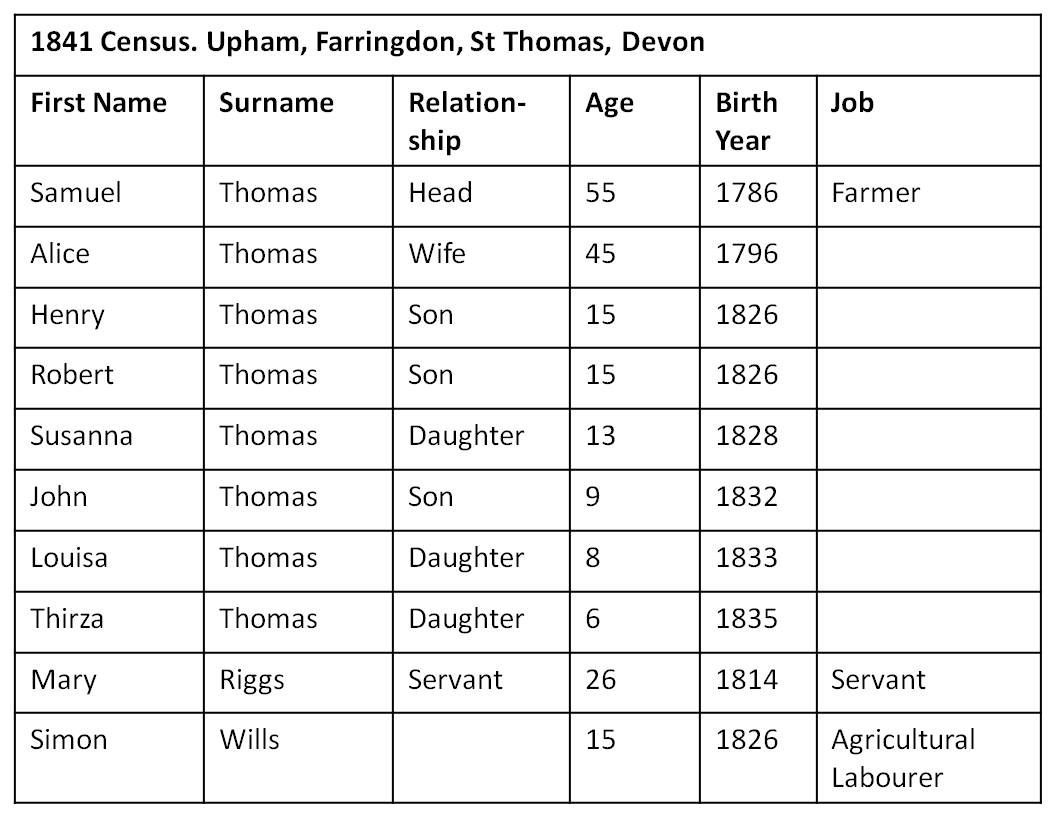
As shown on the 1841 Census: as a young woman, Mary lived with and worked as a servant for the Thomas family - farmer Samuel Thomas, his wife Alice, and their seven children - at Upham (likely Upham Farm) in Farringdon. Whilst Mary worked away, her young son John lived with her parents (his maternal grandparents), her brother Thomas (his Uncle Thomas) and Thomas' wife and baby daughter, all together in Perkings Village, Farringdon.

1841 Census:

In early 1842, when Mary was about twenty-seven, her mother Mary Anne passed away, aged about fifty-seven. Mary Anne was buried on 17th March 1842 in Farringdon.

Mary Anne may have lived just long enough to see her daughter Mary marry. On 17th February 1842, Mary (about 27), a servant, married William Ireland (about 39), a labourer, in Farringdon. On their record of marriage, Mary and William each left only their mark, implying neither could write. Mary's son John is listed with his step-father's surname of Ireland on the 1851 Census; however, when he married as a young man in 1856, he was once more using his mother's maiden name of Riggs. When Mary and William married, Mary was about three months pregnant with their first child, daughter Mary Ann. If wonder if Mary named her daughter for her late mother.

Mary and William had three children (one daughter and two sons):


  • Mary Ann  1842 -
  • William Henry  1844 -
  • Samuel  1848 -


Sometime between 1844 and 1848, Mary and her young family moved from Farringdon about six miles west to Heavitree, near Exeter - there, their youngest child Samuel was baptised in 1848 and Mary and the children can be found in the 1851 Census.

1851 Census:


Mary is listed as the head of the family in the 1851 Census, working and looking after her four children. Where was her husband William? Mary is not listed as a widow, implying William was still alive at that point. Unfortunately William seemed to disappear from record,, particularly censuses, after the baptisms of his three children in the 1840's; however research revealed why...

In February 1850, William, a labouring man in his forties with a wife and four children to support, stole one sheep, and had the misfortune of being caught. For his crime, he was sentenced to seven years transportation to Tasmania, Australia! (otherwise known as Van Diemen's Land)

From the North Devon Journal of 21st February 1850:


After this incident, I wonder if Mary even saw her husband again. He was tried at Exeter Castle on 26th February 1850; two and a half years later, on 4th November 1852, he boarded the Oriental Queen in Plymouth for Australia; and three months later, on 19th February 1853, he arrived in Tasmania.

William's Tasmanian Convict Record paints a picture of Mary's husband. A physical description of the forty-nine year old is given: he was 5'5 1/2''; with a sallow complexion, dark brown hair and eyebrows, and grey eyes; had a large oval head, a large nose and mouth, and a medium-sized forehead and chin. He also had a scar near his right eye. Did their children share his colouring, his features?

He was also described as being Church of England and, touchingly, that he could read a little. For his prison report, he received the mark of exemplary. William's good behaviour must have continued for he applied for and received a ticket of leave on 8th November 1853; and on 17th July 1855, he applied for and received a conditional pardon. Unfortunately I cannot find out anything about William after 1855. We leave him in Australia, an old Devonshire lad, a conditional pardon in his pocket.

10,000 miles away, Mary remained in Devon and struggled to support herself and her four children. She found work as a washerwoman for laundress Mary Saunders of Clifton Street, Exeter. In June 1854, Mary was first charged by Mrs Saunders with embezzlement, but as the evidence was deemed insufficient the case was dismissed.

From the Western Times of 17th June 1854:


She was then charged with stealing a flannel petticoat. Mary was assigned to return the washed petticoat from Saunders' home-business to its owner Mary Elliot, a servant of Miss Ball, Dix's Field. Instead Mary pawned the petticoat at the shop of Mr Bannister, pawnbroker, Milk Street. The prosecutor called for mercy due to her sad circumstances, as a single mother of four, her husband having been transported, yet for stealing the petticoat, Mary was sentenced to six weeks imprisonment, with hard labourer.

From the Western Times of 1st July 1854:


Mary was additionally changed with obtaining 4s 6d by false pretences from Rebecca Mudge. Mary pleaded guilty and was sentences to another six weeks imprisonment, with hard labour, to begin at the end of the previous term (so in all twelve weeks, nearly three months, imprisonment with hard labourer).

From the Exeter Flying Post of 29th June 1854:


With Mary imprisoned for three months, who looked after her children? Her eldest son John would have been around twenty. Did he look after his three younger half-siblings, Mary Ann (about twelve), William (about ten) and Samuel (about six)?

In 1858, when Mary was about forty-four, her father William passed away, aged about eighty. He was buried on 21st November 1858 in Farringdon.

Mary's sons, William and Samuel, later both moved to Wales, where they married and had children of their own; whilst Mary's daughter, Mary Ann, lived in Exeter, Devon, with her husband and children. Mary would live with her daughter and her family. Mary and Mary Ann supported the family by working as laundresses.

1871 Census:


1881 Census:


In late 1882, Mary passed away, aged about sixty-eight, in Exeter. She was buried on Christmas Eve 1882 in St Leonard, Exeter.

At some point, Mary may have set up her own laundry business. Mary and her daughter Mary Ann were listed as laundresses on the 1871 and 1881 Censuses. After Mary's death, her daughter Mary Ann continued to work as a laundress, supported by her own grown-up daughters (Mary's granddaughters) Polly and Kate, who worked as laundry maids and laundry assistants (as shown on the 1891 and 1901 Censuses). After Mary Ann's death, her children continued the business: in the 1911 Census, her son (Mary's grandson) William is listed as a laundry man and employer, his wife a laundress, running a launderette at their home; sisters Polly and Kate living a few houses down, and still working as laundresses for the family business.

Thursday, 2 April 2020

Great x4 Grandfather William Ireland

My Great x4 Grandfather William Ireland (1803 - after 1855) was an agricultural and general labourer and father of three.


William was born around 1803 in Talaton, Devon to William Ireland (about 26), a labourer, and Mary Ireland.

William was baptised on 27th February 1803 in Talaton, Devon.

William was the second of two children (one daughter and one son):


  • Elizabeth 'Betty'  1801 - 1803 (24 months old)
  • William  1803 -


Sadly, when William was only about one month old, his older sister Betty passed away, aged only two years old. Her record of burial lists her cause of death: my hands covered my eyes after reading 'burnt to death'. Little Betty was buried on 21st March 1803 in Talaton.

At some point, either during his boyhood or as a young man, William moved around three miles south-west from Talaton to Whimple. There, with his elderly father of the same name, he lived with and worked as an agricultural labourer for farmer Thomas Elworthy, come the time of the 1841 Census.

1841 Census:


On 17th February 1842, William (about 39), a labourer, married Mary Riggs (about 28), a servant and single mother of one, in Farringdon, Devon. Mary's son John (born 1834) is listed with his step-father's surname of Ireland on the 1851 Census; however, when he married as a young man in 1856, he was once more using his mother's maiden name of Riggs. When William and Mary married, Mary was about three months pregnant with their first child, daughter Mary Ann. On their record of marriage, William and Mary each left only their mark, implying neither could write.

William and Mary had three children (one daughter and two sons):


  • Mary Ann 1842 -
  • William Henry  1844 -
  • Samuel  1848 -


The summer of 1844, when William was about forty-one, his father of the same name passed away, aged about seventy-five. William Senior was buried on 9th July 1844 in Whimple.

Sometime between 1844 and 1848, William and his young family moved from Farringdon about six miles west to Heavitree, near Exeter - there, their youngest child Samuel was baptised in 1848 and Mary and the children can be found in the 1851 Census.

William's wife Mary is listed as the head of the family in the 1851 Census, working and looking after her four children. Where was William? Mary is not listed as a widow, implying William was still alive at that point. Unfortunately William seemed to disappear from record, particularly censuses, after the baptisms of his three children in the 1840's; however, further research revealed why...

In February 1850, William, a married man in his forties with three/four young children, stole one sheep, and had the misfortune of being caught. For his crime, he was sentenced to seven years transportation to Tasmania, Australia! (otherwise known as Van Diemen's Land)

From the North Devon Journal of 21st February 1850:


Though tried at Exeter Castle on 26th February 1850, it wasn't until two and half years later, on 4th November 1852, that William boarded the Oriental Queen in Plymouth for Australia. Over three months later, on 19th February 1853, he arrived in Tasmania.

His Tasmanian Convict Record gives a physical description of forty-nine year old William: he was 5'5 1/2''; with a sallow complexion, dark brown hair and eyebrows, and grey eyes; had a large oval head, a large nose and mouth, and a medium-sized forehead and chin. He also had a scar near his right eye.

He was also described as being Church of England and, touchingly, that he could read a little. For his prison report, he received the mark of exemplary. William's good behaviour must have continued for he applied for and received a ticket of leave on 8th November 1853; and on 17th July 1855, he applied for and received a conditional pardon.

Unfortunately I cannot find out anything about William after 1855. We leave him in Australia, an old Devonshire lad, a conditional pardon in his pocket.

Tuesday, 2 October 2018

Great x3 Grandmother Mary Ann Manning (nee Ireland)

My Great x3 Grandmother Mary Ann (1842 - 1908) was a laundress, housewife, and mother of nine.


Mary Ann Ireland was born around 1842 in Farringdon, Devon to William Ireland, a labourer, and Mary Ireland (nee Riggs) (about 28), a servant and laundress.

Mary Ann was baptised on 14th August 1842 in Farringdon, Devon. Mary Ann's parents had only married in the February of that year, meaning her mother was about three months pregnant with Mary Ann when she married.

Mary Ann had an older half brother, John, the illegitimate son of her mother Mary, born in 1834. On the 1851 Census, he is listed with the surname of Ireland, but when he married as a young man in 1856 he was once more using the surname of Riggs.

Mary Ann was the eldest of three children (one daughter and two sons) born to William and Mary:

  • Mary Ann 1842 - 
  • William Henry  1844 -
  • Samuel  1848 - 

Sometime between 1844 and 1848, young Mary Ann and her family moved from Farringdon about six miles west to Heavitree, near Exeter.

1851 Census:


Mary Ann's mother Mary was the head of the family by 1851, working and looking after her four children. Where was Mary Ann's father William? In February 1850, when Mary was about seven years old, her father William stole one sheep from a field in Heavitree. For this crime, he was transported to Van Dieman's Land!

Mary Ann's mother struggled to support her family. She found work as a washerwoman for laundress Mary Saunders of Clifton Street, Exeter. In the summer of 1855, when Mary Ann was about twelve, her mother Mary was sentenced to twelve weeks imprisonment, with hard labourer, for stealing a flannel petticoat (instead of returning the washed petticoat from the launderette to its owner, she pawned it) and for obtaining 4s 6d by false pretences from Rebecca Mudge.

With her mother imprisoned who looked after Mary (twelve) and her younger brothers, William (ten) and Samuel (six)? I wonder if their older half-brother, John Riggs, who would have been around twenty at the time, looked after his younger half-siblings.

I cannot find Mary Ann in the 1861 Census, meaning we know little of her life as a young woman.

Too I cannot find a record of marriage between Mary Ann and labourer and former soldier William Manning, but they were certainly together by mid 1864, when Mary Ann about twenty-two, for by April 1865 (9 months later) their first child, Emma, was born in Exeter. Record of her baptism the next month in Exeter list both parents.

Mary Ann and William had nine children (five daughters and four sons):

  • Emma  1865 - 1866 (11 months)
  • William  1868 -
  • Mary Ann 'Polly'  1869 -
  • Kate  1871 -
  • Rose  1875 - 1877 (2 years old)
  • Samuel  1877 - 1877 (7 or 8 years old)
  • Unnamed Daughter  1880 - 1880 (0 years old)
  • Frederick John  1882 - 1882 (6 weeks old)

Very sadly six (two thirds) of Mary Ann and William's children passed away in infancy. Their eldest child Emma passed away aged eleven months in 1866; over the next few years, they then had three children that survived into adulthood - William, Polly and Kate -; their fifth child Rose (two years old) and sixth child Samuel (eleven weeks old) both passed away in 1877; their seventh child James made it through his earliest years, but passed away aged seven or eight in 1887; their eighth child, an unnamed daughter, was born after a six months pregnancy in 1880 and passed away soon after; and their ninth and youngest child Frederick passed away at six weeks old in 1882.

Why did so many of Mary Ann and William's children pass away so young? My initial gut theory was syphilis, which can cause poor pregnancy outcomes. The mother can have many children, but few survive, as is the case here. However, William was dismissed from the army in 1865 for showing signs of tuberculosis. Did his illness affect the survival of his children? Did he pass it on to them?

Most persons with tuberculosis in the 1800's did not live long with the disease; however, after showing signs in his mid thirties in the mid 1860's, William went on to have nine children, and life for another thirty years, into his mid sixties. I wonder: did he indeed have tuberculosis and was the anomaly who lived long with it? Or was his misdiagnosed and suffered from another condition from which he recovered and lived for many years, or could more likely survive with for many years? Yet, even back then, tuberculosis was well known and easily diagnosed.

Later censuses list William as a labourer, however the females of the family - Mary Ann, her mother, and daughters - are listed too as laundresses or laundry maids. Mary Ann is listed as the employer - she is the running the launderette in her home, employing her relations. It seems likely her business was the family's main income, whilst ill William did the little labour he could.

Mary Ann's life was tough: she saw child after child pass away, and most likely cared too for an ill husband. It is reassuring to see her mother Mary living with the family, supporting her daughter.

1871 Census:


In the 1870's, Mary Ann's surviving children attended Rack Street Central School in Exeter's poor West Quarter. It was reported that many of the school's poor pupils started their day with a Farthing Breakfast at the Coombe Street mission, before walking to school.

1881 Census:


In 1882, when Mary Ann was forty, her mother Mary passed away, aged about sixty-eight, in Exeter. She was buried on Christmas Eve 1882 in Exeter.

Jubilee Street, where Mary Ann and her family lived, was at the bottom of Weirfield Road in Exeter, and consisted of rows of slum terraced houses, close to the River Exe. Sometime in the 1880's, Mary Ann and her surviving family moved from Jubilee Street just around the corner to 4 Colleton Grove.

1891 Census:


The 1891 Census lists Mary Ann's teenage daughter Kate as deaf.

In 1895, when Mary Ann was about fifty-two, her husband William passed away, aged sixty-five, in Exeter. He was buried on 9th March 1895 in Exeter. Eight months later, on 30th November 1895, Mary Ann's surviving son William, a porter, married in Exeter. Mary Ann acted as witness, signing her name on the marriage certificate.

Mary Ann Manning (nee Ireland)'s signature, 1895

1901 Census:


Mary Ann passed away, aged about sixty-six, in 1908 in Exeter. She was buried on 1st November 1908.

It seems her son William, listed as a laundry assistant in the 1901 Census, took over Mary Ann's laundry business after her death. The 1911 Census shows him living three doors down at 1 Colleton Grove (his laundress sisters remain at 4 Colleton Grove); there he is listed as a laundry man and employer, and his wife a laundress, running a launderette at their home, like Mary Ann had done before.