My Great x3 Uncle Ernest (1878 - 1903) was a farm servant, wagoner and carter for a corn dealer and forage merchant, father of four, and the younger brother of my Great Great Grandfather Isaac 'Harry' Harwood Vernon (1869 - 1934).

Ernest was born around July 1878, in the district of Crediton, Devon, to William Vernon (about 49), an agricultural labourer, and Martha Vernon (nee Dyment) (about 45), a housewife.
Ernest was the youngest of twelve children (five daughters and seven sons):
- Susan 1854 - 1930 (75 years old)
- Thomas 1857 - 1916 (about 59 years old)
- William 'Robert' Robert 1859 - 1939 (about 80 years old)
- Sarah Ann 1860 - 1901 (about 40 years old)
- Silas 1862 - 1933 (71 years old)
- Mary 'Jane' Jane 1864 - 1930 (66 years old)
- Arthur 'John' John 1865 - After 1881 (At least 16 years old)
- Isaac 'Harry' Harwood 1869 - 1934 (65 years old)
- Martha 1871 -
- Louisa 1872 - 1874 (16 months old)
- Samuel 'Sam' Reuben 1875 -
- Ernest 1878 - 1903 (25 years old)
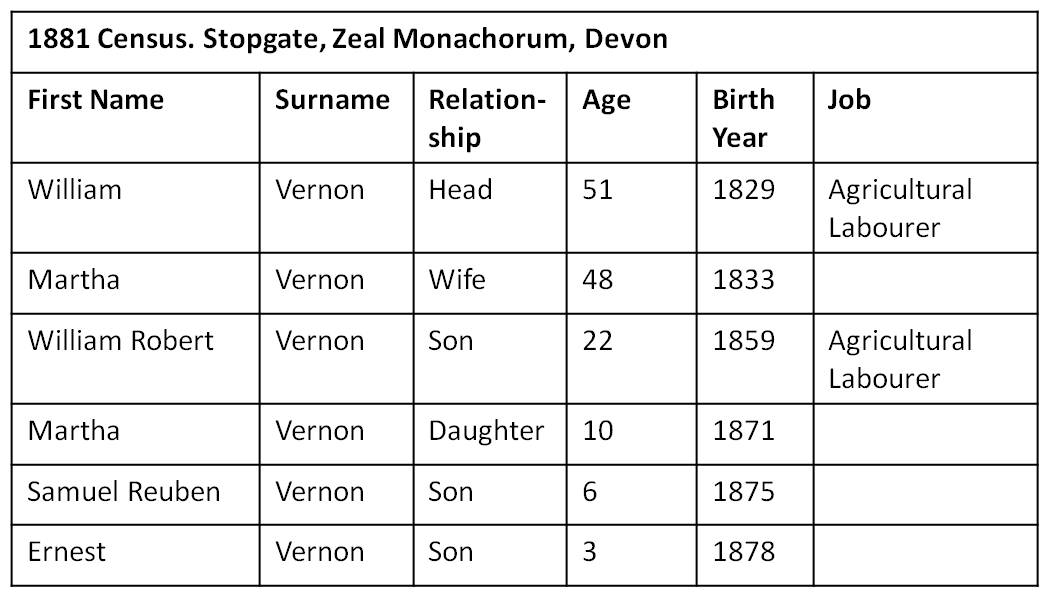
1881 Census:
1891 Census:

In Apr/May/Jun 1899, Ernest (20), a carter for a corn and forage dealer, married Elizabeth Morrish (25), in Exeter.
Ernest and Elizabeth had four children (three sons and one daughter):
- Ernest 'Reggie' Reginald 1900 -
- Albert 'John' John 1901 -
- Charles Percy 1902 - 1903 (14 months)
- Dorothy Jane 1904 -
1901 Census:

At the turn of the 20th century, the young family could be found living at 3 Mary Arches Street, Exeter. Ernest' older brother Sam also lived on Mary Arches Street - only three doors down at no. 6. Sam was the sibling closest in age to Ernest. The brothers may well have been close.
By July 1903, Ernest, Elizabeth and their three infant sons had moved to 11 Artizan's Dwellings, Rack Street. Ernest and Elizabeth must have been working hard to save up, for it was reported that, rather than renting, they owned their new home. Alas only a few days after moving in, a tragedy struck...
On 10th July 1903, Ernest was sent from Exeter to fetch a delivery of vetches for his boss - Mr Horwill, a corn dealer and forage merchant - from farmer John Osmond at Woodrow Farm, Brampford Speke. Going the nearest way, he had to pass the level crossing at Stafford Bridge, about 200 yards off the Stoke Canon road. Ernest arrived safely at the farm, but not finding Mr Osmond at home, had left the waggon there, and walked back to the crossing.
Ernest soon came across Mr Osmond, and spoke to him about the vetches he had to sent to collect. As they conversed, Ernest continued to walk along the railway line, towards a nearby gate. Mr Osmond, who was not on the line, realised a train was coming that way and shouted out to Ernest to warn him. Ernest either heard the warning, or at least heard Mr Osmond speak to him, for he replied - his last words - 'All right, Master'. But Ernest, if he did hear the warning, either believed the oncoming train to be on the other line, or that he had more time to cross the line that he and the train were both on to get to the nearby gate. For a second later, Mr Osmond saw Ernest's straw hat fly into the air, as the train struck the poor young father. Ernest was killed instantly, struck in the head - his arms were also badly injured. If there was any mercy, it was that he didn't suffer long. He was just twenty-five years old.
From the Western Times of 11th July 1903:


From the Western Times of 13th July 1903:


Ernest's brother, Sam, cycled from Exeter to Brampford Speke to identify his baby brother's body. Four days later, on 14th July 1903, Ernest was buried in St Mary Major, Exeter. Another older brother, Harry, would name his next born son Ernest after his late brother.
Suddenly without their breadwinner, though grieving, pregnant and with three/four very young children to care for, Elizabeth worked as a charwoman to support her family.
Alas only three months after Ernest was killed, Elizabeth suffered another lost. Their youngest son, Charles, passed away, aged only fourteen months, in October 1903. He was buried on 29th October 1903, in St Mary Major, Exeter.
Elizabeth must have fallen pregnant with her and Ernest's youngest child - daughter Elizabeth - just before he passed, for Dorothy was born around March 1904, about eight months after her father's passing. Elizabeth may have not even known she was pregnant when Ernest was killed (What with there being no pregnancy tests and all. She may have missed a period - but that's no guarantee of pregnancy. She may have just known - some women say their body feels different - but did Ernest know? He never met his little girl, but did he know he/she were on their way?)
On 31st May 1909, nearly six years after Ernest's passing, Elizabeth (36) remarried, and young Reggie, John and Dorothy gained a step-father in London-born general/fish dealer, Thomas Griffin (29); followed by two younger step-siblings - twins Violet May and Hilda Maud Griffin - in 1910. The older siblings kept their father's surname of Vernon. The Griffin/Vernon family could be found living on (the often photographed) Stepcote Hill (no. 26) in Exeter, around 1911.
Alas delving further into newspaper and prison records showed Thomas in a less than wholesome light. We won't hold the fact he had one leg against him, though it was a surprise to discover. Though the greater surprise was the lengthening list of crimes to his name: stealing eggs, stealing a wheel, stealing rabbit skins, stealing money, arson (setting fire to a stack of hay), leaving his horse unattended, driving his steam wagon without a number plate, and - most tragically in relation to the Vernon family - barely two years into his marriage, adultery and child neglect.
From Thomas' 1905 Prison Record:

By 1912, Elizabeth and Thomas were living apart. What contrasting figures: she 'hard-working', he 'lazy'. Thomas was constantly in and out of prison - in fact the last time he was arrested, he had been 'stood outside the workhouse gates, his arm around a woman's waist'. His old excuse for his every crime: he struggled to find work because he only had one leg. He was cohabiting with a woman not his wife and had an illegitimate child. Every penny Elizabeth had earned, Thomas wasted. I can't blame her for not wanting him back. She said she would maintain her older children, she only asked for financial support for the twins, her children by Thomas. Though he threatened, she took him repeatedly to court. Meanwhile she worked her socks off: she ran their fried fish shop, let lodgings, went out and found additional work as a charwoman (like she did after Ernest passed). She was respected as 'a hard-working woman, who did the best for her children'.
From the Western Times of 5th January 1912:

From the Western Times of 4th June 1912:


From the Western Times of 28th January 1913:

From the Exeter and Plymouth Gazette of 28th January 1913:

Elizabeth outlived Ernest by three and half decades. She passed away, aged sixty-five, on 12th January 1939, in Exeter, mourned by her children.
From the Express and Echo of 12th January 1940:


